
Reviewed · GYEONGJU AND BUSAN MULTI-DAY TRIPS FROM SEOUL
3-Days 2-Nights Gyeongju UNESCO Sites & Busan City [Private Tour from Seoul]
Gyeongju gives you Korea’s ancient soul, while Busan brings seafood markets, sea views, beaches, and city energy. This private three-day trip links both places without asking you to sort out trains, hotels, taxis, or admission tickets on your own. I especially like the mix of Silla-era monuments and Busan’s working waterfront, plus the comfort of a private Kia Carnival-style vehicle on the long roads from Seoul.
I also like the flexible pace. Guides such as Shane, Benny, Alfonso, and Jimmy have been praised for safe driving, rest stops, restaurant help, and adjusting the day to personal interests. The tradeoff is clear: this is a lot of Korea in only three days, and the drive between Seoul, Gyeongju, and Busan takes time.
Key points to know before booking
- Gyeongju is the cultural heart of the trip: Royal tombs, Cheomseongdae, Bulguksa, Seokguram, and palace ruins explain Korea’s Silla past.
- Busan supplies the variety: You move from Jagalchi seafood stalls to a coastal skywalk, a famous beach, hillside homes, and a temple by the sea.
- Private transport saves planning time: Hotel pickup, a private vehicle, a driving guide, and return transport are included.
- The long-distance route is comfortable but demanding: Rest stops help, yet Seoul to the southeast and back makes this a packed schedule.
- Two hotel nights and breakfasts are included: The accommodation is in 3-star hotels, keeping the tour practical rather than luxurious.
- The price reflects convenience: At $1,104 per person, the value depends on how much you value private service, included admissions, hotels, and time saved.
Why this route works for a short Korea visit
If you have already seen Seoul or only have a few spare days, this tour gives you two very different sides of South Korea. Gyeongju was the capital of the Silla Dynasty for about a thousand years. Busan is the country’s second-largest city, with a strong port identity and a long Pacific coast.
That contrast is the real appeal. In Gyeongju, the focus is archaeology, Buddhist art, royal burial grounds, and old court life. In Busan, the focus shifts to seafood, shopping streets, ocean views, modern architecture, and neighborhoods built into hillsides.
I would not choose this trip if you want slow mornings or long meals. The itinerary has four stops on day one, six on day two, and four on day three. Still, the private format helps. You are not tied to a large group’s pace, and the guide can make small adjustments, include coffee or tea breaks, and help with food choices.
The tour is rated 4.5 out of 5, with 91 percent recommending it. The strongest pattern is not one single monument. It is the care provided by the guide and driver. Safe driving matters here because the route covers a lot of ground.
More Gyeongju and Busan trips from Seoul:
- 5-Day Korea Golden route by K-shuttle Tour from Seoul Including Busan, Yeosu
★ 4.5 · 37 reviews - Andong Hahoe Village [UNESCO site] Premium Private Tour from Seoul
★ 5.0 · 24 reviews - Danyang Tour:Guinsa Temple & Bobaljae & Cheongpung Cable Car
★ 5.0 · 15 reviews
Day one: Gyeongju’s royal tombs and moonlit palace ruins
Your first day begins with Gyeongju National Museum, a smart starting point because it gives context before you visit the monuments. Allow about 90 minutes. The museum holds artifacts from the Silla period and helps you understand why Gyeongju is often treated as an open-air record of Korea’s early history.
This stop is especially useful if you do not already know the difference between a Buddhist relic, a royal burial object, and a palace site. Instead of seeing a series of attractive old places without context, you begin with objects and explanations that make the rest of the day easier to follow.
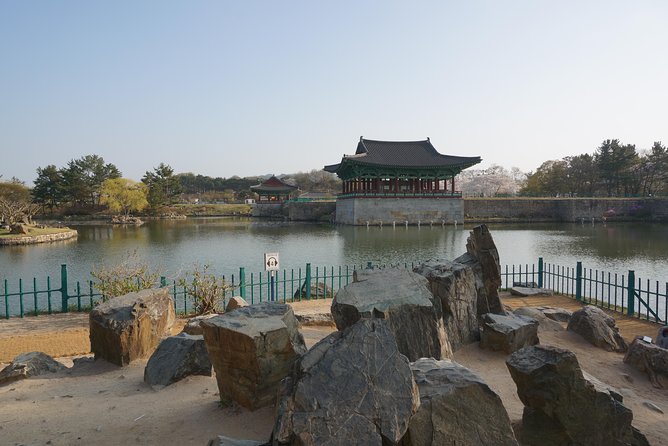
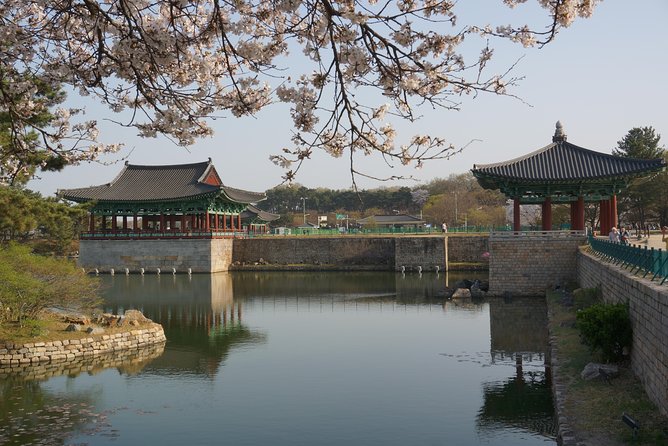
Next comes Donggung Palace and Wolji Pond, formerly the site of an eastern palace used by the crown prince. The visit lasts about 40 minutes. The pond and palace remains are particularly attractive later in the day, when reflections and lighting give the site a calmer feel.
The drawback is that little of the original palace survives. You are reading the site through foundations, reconstructions, and the setting around the pond. A guide adds real value here by explaining what the buildings once did rather than leaving you with ruins and a photo stop.
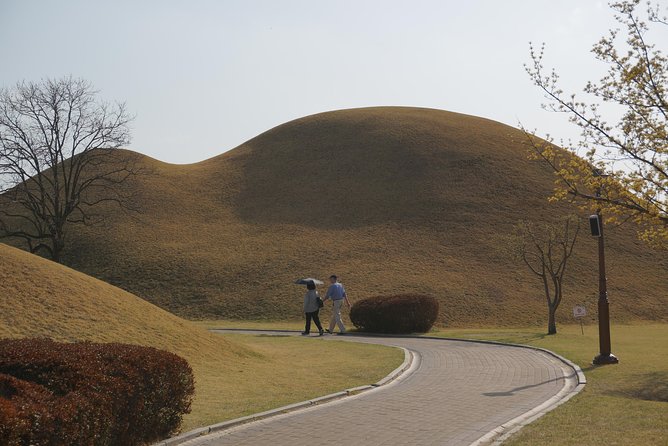
After that, you visit Cheonmachong Tomb inside the Daereungwon Tomb Complex. Plan on roughly 90 minutes. This large burial mound was excavated in 1973 and is known as Ancient Tomb No. 155. Inside, you can see the scale of Silla royal burial practices and learn how the mound protected objects placed with the dead.
The tomb complex also gives you one of Gyeongju’s most recognizable scenes: rounded green burial mounds spread across the city. It feels different from a standard palace visit. The power here comes from the scale and mystery of the graves, not from grand buildings.
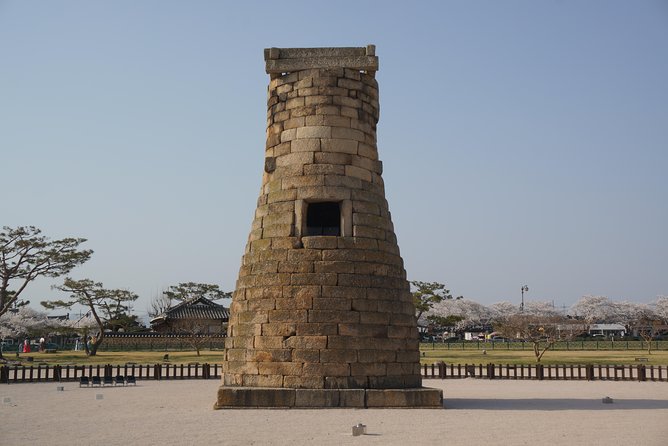
Cheomseongdae Observatory finishes the day. The stop is about 30 minutes. Built during the reign of Queen Seondeok, it is described as the oldest existing astronomical observatory in Asia. Its stone construction is modest in size, so do not expect a towering monument. The importance is scientific and historical, tied to the Silla court’s interest in the heavens and the calendar.
The first day is well arranged in terms of subject matter. You begin with museum context, then move through palace remains, royal tombs, and astronomy. It is a full day, but the stops are close enough in theme to feel connected.
Day two: Buddhist masterpieces before Busan’s port districts
Day two starts with Seokguram, high on Tohamsan Mountain. The visit takes about an hour. You reach the monument by a distinctive forest path, then see the large granite Buddha inside the grotto.
Seokguram is one of the most important Buddhist monuments in the Gyeongju area, and the setting matters. The approach through the trees creates a change of mood after the city sites of day one. This is a place for quiet attention rather than a quick checklist stop.
You should know that the Buddha is viewed from a protected area rather than approached in the way you might enter an ordinary temple hall. The visit is still worthwhile, but expectations matter. The significance lies in the sculpture, the engineering, and the Unified Silla period setting.
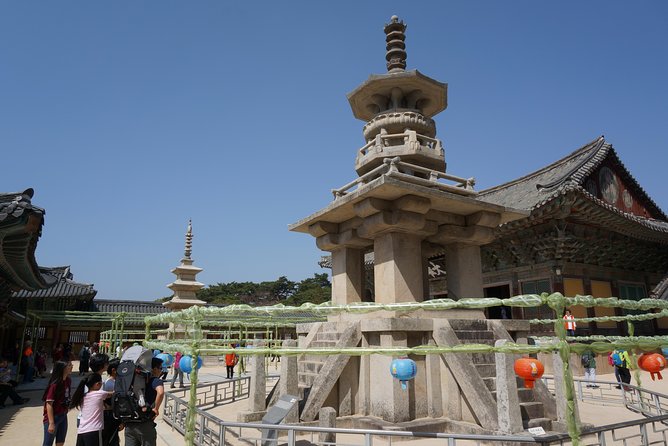
Bulguksa Temple follows, with about 90 minutes to explore. It is one of Korea’s best-known Buddhist temples and a major Gyeongju sight. Stone stairways, pagodas, courtyards, and wooden halls make this a more expansive visit than Seokguram.
The two stops work well together. Seokguram shows Buddhist art in a compact mountain setting, while Bulguksa presents a larger temple complex with more architectural variety. Both are UNESCO World Heritage Sites, and both help explain why Gyeongju is more than a collection of old burial mounds.
After the Gyeongju visits, the tour moves to Busan. The change from ancient capital to port city is quick and noticeable. Your first Busan stop is Yongdusan Park, where you spend about 40 minutes. The park sits on a 49-meter hill in the center of town and offers broad views across the city.
It is a practical first look at Busan because you can get your bearings from above. The stop is free, and the urban setting makes clear how compact yet crowded the central districts can feel.
From Yongdusan, you move toward BIFF Square for about an hour. The area is associated with the Busan International Film Festival and forms part of a busy shopping zone between Jagalchi Market and the International Market. It is often compared with Myeongdong in Seoul, though the atmosphere is distinctly Busan.
This is a good place to leave room for snacks or a quick look at local shopping. Food is not included, so your guide can be useful when you want help choosing what to eat. Past guide assignments, including Benny and Jimmy, have been praised for helping with restaurant decisions and giving visitors space to explore.
Jagalchi Market is next, with about an hour. This is Busan’s famous seafood market and one of the clearest reminders that the city is a working port, not simply a beach destination. You can see a wide range of seafood, and sashimi is available for those who eat it.
Lunch and dinner are not included, so budget separately for meals. That arrangement gives you choice, but you should not assume every food expense is covered by the tour price.
The day ends at Oryukdo Skywalk. Allow about an hour. This is the coastal stop, with views over the water and Busan’s shore. The glass-floored walkway is the main attraction, but the larger value is the chance to step away from the market streets and see the city from its edge.
Day two is the most demanding day. It combines two major cultural sites in Gyeongju with four Busan stops. If you tire easily, tell the guide early. The private format makes short breaks possible, and previous guests have specifically appreciated regular coffee and tea stops during long drives.
Day three: Busan’s coast, beach, and hillside village
Your final morning begins at Haedong Yonggungsa, a Buddhist temple built beside the coast rather than in the mountains. Allow about an hour. That setting is the reason this temple is so popular: stairs, shrines, and ocean views come together in a way that feels very different from Bulguksa.
The site can be visually busy, especially at popular times. Give yourself time to look beyond the first photo point. The best part is the relationship between the temple structures and the shoreline.
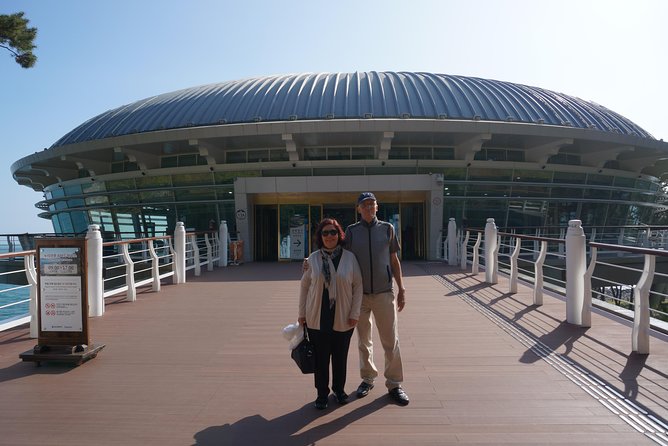
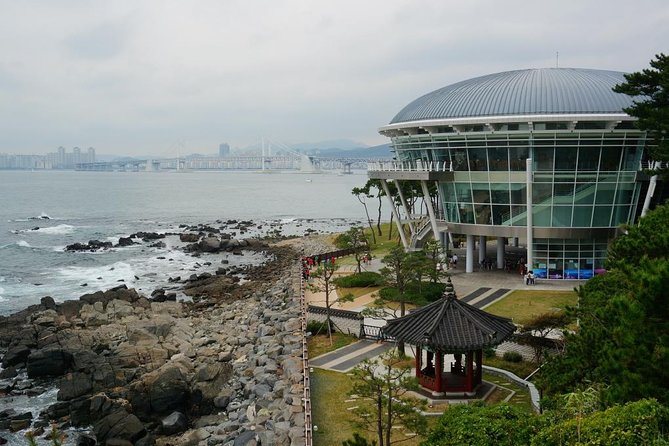
Next comes APEC Naru Park, a free 40-minute stop along the coast. The area includes the building used for the 2005 APEC meeting, when representatives from 21 countries gathered in Busan. You can walk along the shore after seeing the building.
This is a lighter stop than the temples and museums. It gives your legs a break while keeping you near the water. It also adds a modern political and architectural note to a trip that otherwise leans heavily toward ancient Korea.
Haeundae Beach follows for about 40 minutes. It is Korea’s most famous beach and lies in the center of Busan. You will have enough time for a walk, photographs, and a look at one of the city’s best-known public spaces.
Do not expect a secluded beach experience. Haeundae is famous precisely because it is central and heavily visited. Its value is as a Busan landmark and as a contrast to the rocky coast near Haedong Yonggungsa and Oryukdo.
The final stop is Busan Gamcheon Culture Village, with about 50 minutes. The village was built on a mountainside by people evacuated from North Korea during the Korean War and is now known for its colorful scenery and steep streets.
This stop has strong visual appeal, but it is also a real neighborhood turned into a sightseeing area. Wear comfortable shoes if you plan to walk beyond the main viewpoints. Fifty minutes is enough for a taste, though not enough for an unhurried wander through every lane.
The tour then returns you to Seoul. Exact driving times are not provided, but the route is long enough that this final transfer should be treated as part of the day, not as an afterthought. If you have an early flight or fixed evening plans in Seoul, leave plenty of extra time.
More private tours in Seoul:
- Private DMZ Tour (No Shopping): 3rd Tunnel & Suspension Bridge
★ 5.0 · 607 reviews - Seoul City Private Full-Day Tour Including Lunch
★ 5.0 · 469 reviews - Private DMZ the 3rd Tunnel Tour from Seoul (optional Red Bridge)
★ 5.0 · 429 reviews - Seoul Highlights & Hidden Gems Tours by Locals: Private + Custom
★ 5.0 · 359 reviews
What the $1,104 price gives you
At $1,104 per person, this is not a budget excursion. The price includes two nights in 3-star hotels, two breakfasts, private transportation in an air-conditioned vehicle, a private driving guide, hotel pickup and return, admissions, fees, and taxes.
That package can be good value for a family or small group that would otherwise arrange intercity transport, hotels, taxis, temple admissions, and local navigation separately. You are also paying for the ability to ask for a break, spend longer at a favorite stop, or get help finding food.
The value is weaker if you are comfortable using Korea’s public transportation and already have hotels booked. You would be giving up some independence and paying for convenience you might not need.
Accommodation is practical rather than upscale. The hotels are 3-star, and the included meals are breakfasts only. Ask about the hotel names and room arrangements before booking if those details matter to you, since they are not specified here.
Who will enjoy this private tour most
I would recommend this trip for a first visit to Gyeongju and Busan when you have limited time and want the major sights handled in one package. It suits families, couples, and small groups who value a private vehicle and do not want to manage a complicated three-city route.
It is also a good fit if you want a guide who can explain the sites and help with meals. Guides assigned to this experience have included Shane, Benny, Alfonso, and Jimmy. Their praised strengths include safe driving, patience, local advice, and flexibility, though a specific guide cannot be guaranteed.
I would be more cautious if you prefer slow travel. The schedule is full, the Seoul transfers are long, and some stops are brief. Independent visitors may prefer to spend several nights in Gyeongju or Busan instead of covering both cities at this speed.
You should also be ready to pay for lunch, dinner, and drinks. Those costs are separate, and seafood at Jagalchi can vary in price depending on what you choose.
Booking details worth checking
The tour offers hotel pickup and return, mobile tickets, group discounts, and a private format where only your group participates. Most people can take part, children must be accompanied by an adult, and service animals are allowed.
Confirmation is normally provided at booking. If you book within five days of departure, confirmation can take up to 48 hours and depends on availability.
The cancellation policy is strict near departure. You receive a full refund when canceling at least six full days ahead, 50 percent when canceling two to six full days ahead, and no refund for cancellations less than two full days before the start time. Changes inside those cutoffs are not accepted.
Should you book it?
Book this tour if you want maximum convenience in minimum time. The strongest reasons are the private vehicle, included hotels and admissions, and the chance to see Gyeongju’s major heritage sites alongside Busan’s coast and markets.
Skip it if you want a relaxed schedule, luxury hotels, or the freedom to build your own days. For most short-stay visitors, though, this is a sensible way to connect Seoul with two very different Korean cities, provided you accept the long drives and the fairly high price.
FAQ
Where does the tour start and finish?
The tour starts with hotel pickup in Seoul and includes transportation back to Seoul after the three-day itinerary.
How long is the experience?
The tour lasts approximately three days and includes two nights of accommodation.
Is this a private tour?
Yes. Only your group participates, and private transportation with a private driving guide is included.
What accommodation is included?
Two nights in 3-star hotels are included. The specific hotel names are not provided.
Are meals included?
Two breakfasts are included. Lunch, dinner, personal food, and drinks are not included.
Which UNESCO-related places are visited?
The itinerary includes Seokguram and Bulguksa Temple in Gyeongju, along with other major heritage sites in the historic city.
Are admission fees included?
Yes. Admission tickets are included for Gyeongju National Museum, Donggung Palace and Wolji Pond, Cheonmachong Tomb, Seokguram, Bulguksa Temple, and Haedong Yonggungsa.
Can children join the tour?
Yes, but children must be accompanied by an adult.
What is the cancellation policy?
Cancel at least six full days before the start time for a full refund. Cancellation two to six full days ahead receives a 50 percent refund. Cancellations less than two full days before departure are nonrefundable.
Just added around Seoul
- Your Personal Seoul Photographer!★ 4.1 · 15 reviews
- From Seoul: Hwacheon Ice Fishing and Lighting Festival Tour★ 4.5 · 4 reviews
- You’re Invited to Our Home in Seoul: The Only Cooking Class!★ 5.0 · 8 reviews
- Seoul: Gangneung BTS K-Pop & K-Drama Filming Locations Tour★ 4.6 · 14 reviews
- Unique Native Experience : Han River Picnic, Board game, BBQ★ 5.0 · 3 reviews
- 2-Hour Private Kayaking and Paddleboarding Experience in Hanriver★ 5.0 · 3 reviews
- Yun Korean Cooking Class in Seoul★ 5.0 · 6 reviews
- Vivaldi Park Winter Ski Resort with Nami Island Tour from Seoul★ 4.5 · 7 reviews
Gyeongju and Busan Multi-Day Trips from Seoul, compared.
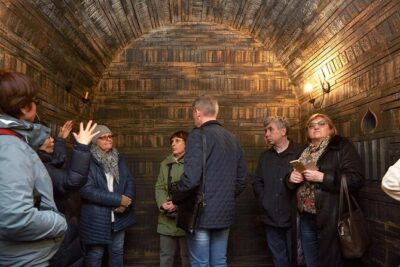
5-Day Korea Golden route by K-shuttle Tour from Seoul Including Busan, Yeosu
Read our review →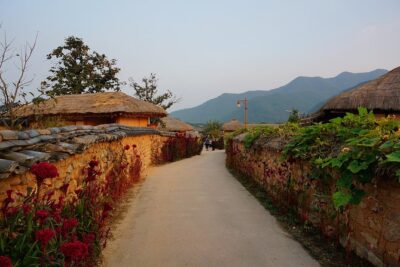
Andong Hahoe Village [UNESCO site] Premium Private Tour from Seoul
Read our review →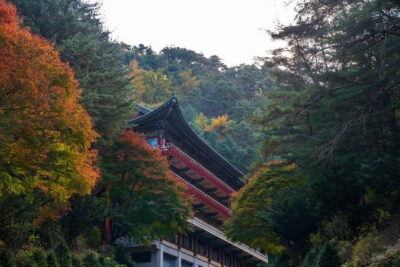
Danyang Tour:Guinsa Temple & Bobaljae & Cheongpung Cable Car
Read our review →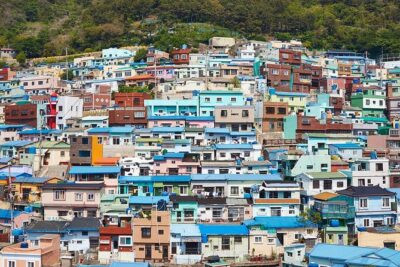
Small Group 7D Korea package Tour with Seoul Gyeongju Busan Jeju
Read our review →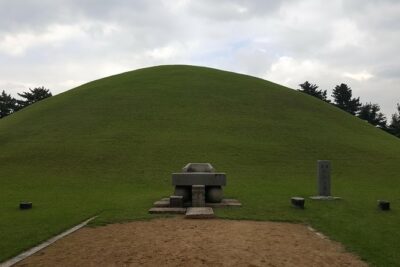
Gyeongju UNESCO Sites Tour by KTX train; The Museum Without walls
Read our review →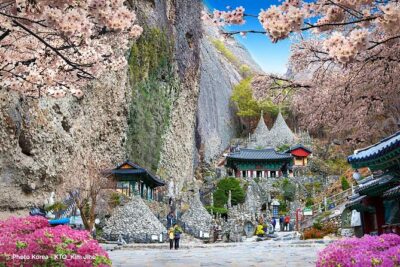
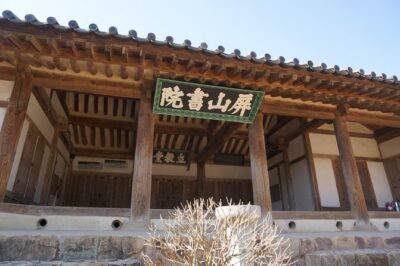
Andong Hahoe Folk Village [UNESCO World Heritage] Private Tour from Seoul
Read our review →
Browse the lists this tour appears in