
Reviewed · SEOUL WALKING TOURS
Seoul History Walking Tour
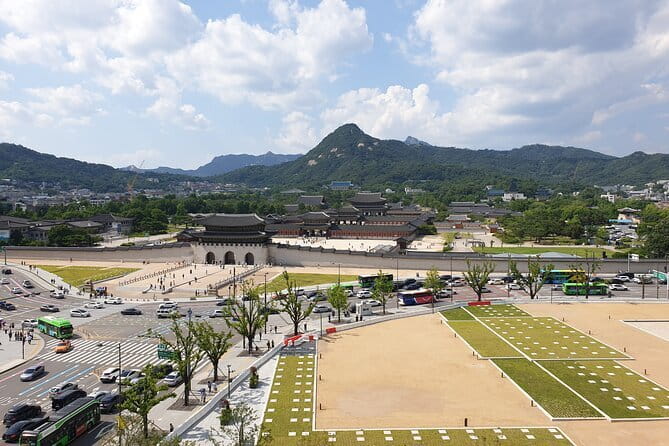
Seoul’s past comes into focus on foot here, one city block at a time. Over about three and a half hours, you follow the story from the Joseon Dynasty through Japanese occupation, war, dictatorship, democracy, and the modern capital. The route links famous statues and plazas with less obvious places such as Jungmyeongjeon Hall and the former Russian Legation.
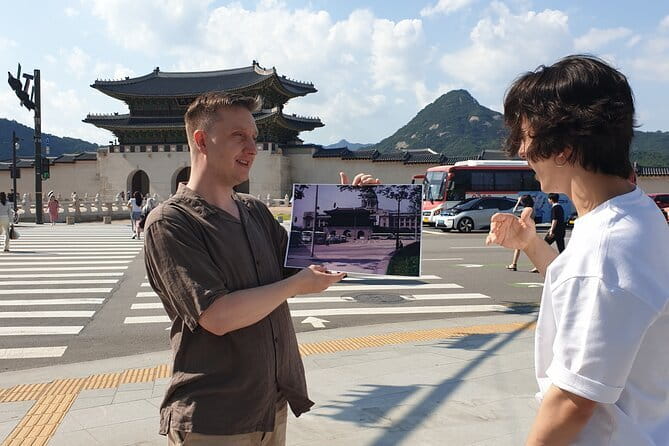
I like the small maximum of eight people, which gives you room to ask questions instead of simply trailing behind a flag. I also like the range of subjects: King Sejong and Admiral Yi Sun-sin share the route with women’s education, political protest, and the everyday role of Cheonggyecheon Stream. The possible drawback is pace. Fifteen stops in 3.5 hours means some places receive only a short explanation, and you will be outside for most of the afternoon.
Key points to know before booking
- Fifteen central Seoul stops: The route covers Bosingak, Cheonggyecheon Stream, Deoksugung, Gwanghwamun Square, Jogyesa Temple, and several lesser-known historic sites.
- A compact group: The tour accepts no more than eight people, a useful setup for questions and conversation.
- A modern political story: Democracy protests, dictatorship, Japanese rule, and women’s education receive as much attention as royal history.
- A convenient afternoon schedule: Meet at 2:30 pm at Bosingak Bell Pavilion and finish near Jogyesa Temple, close to the starting area.
- Good value at $26.60: The fee includes traditional Korean snacks and an informative memento, while all listed stops are free to enter.
- Plan ahead: The experience is booked about 81 days in advance on average, so last-minute availability may be limited.
Why this route gives Seoul a human scale
Many city tours rush from palace gate to palace gate. This one uses Seoul’s central streets as a timeline. You begin with the old bell that regulated daily life, pass through places tied to royal power and foreign pressure, then arrive at the squares and monuments connected to modern citizenship.
That structure matters. You do not just hear that Seoul changed. You see how one period led into the next. The tour asks practical questions along the way, such as why bells rang at different times, why a king left his palace, and how public protest helped shape democracy.
The Australian guide adds an outside perspective without removing the Korean focus. Eric is the named guide connected with the experience, and the tour is designed around explanation and questions. A small group makes that format work better than it would with a large crowd.
This is not a tour built around entering major paid attractions. Every listed stop has free admission, so your money pays mainly for the guide’s time, the route, the historical connections, Korean snacks, and the small memento. At $26.60, that is a fair price if you want context rather than only photographs.
More walking tours in Seoul:
- Seoul moonlight walking tour with local historian
★ 5.0 · 940 reviews - Seoul: Nighttime Hidden Gems Walking Tour
★ 5.0 · 775 reviews - Seoul: Evening Dark History, Folklore & Ghost Story Walking Tour
★ 5.0 · 593 reviews
Bosingak and Cheonggyecheon: Seoul before the modern skyline
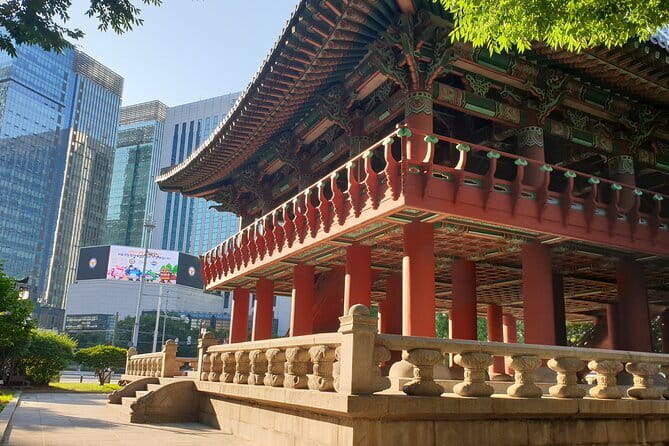
Start at Bosingak Bell Pavilion at 2:30 pm. The first stop takes about 15 minutes and introduces a simple object with a large civic role. The tour explains why the city bell rang 28 times at night and 33 times in the morning, giving you a quick look at how Joseon-era Seoul organized time and public life.
From there, you walk to Cheonggyecheon Stream for about 40 minutes. This is one of the longer stops, and rightly so. The stream lets the guide connect several periods in one place: the Joseon Dynasty, the Korean War, and modern Seoul.
You will learn what the waterway provided in each era rather than treating it as only a pleasant urban feature. That wider story gives the stream more meaning. It becomes a way to think about daily life, hardship, rebuilding, and the city’s modern identity.
The stop also sets the tone for the whole afternoon. Seoul’s history is not confined to palace walls. It is underfoot, beside roads, and in spaces that people still use. Wear comfortable shoes, since the route is a walking experience from beginning to end.
City Hall, Seoul Plaza, and a royal viewpoint
The next stops shift between official buildings and public space. Seoul City Hall receives only about five minutes, but the guide points out why its architecture matters both outside and inside. Since the visit is brief, think of this as a focused explanation rather than an architectural tour.
At Seoul Plaza, the tour spends about 10 minutes asking how the square reflects the feelings of modern citizens. This is an important change in emphasis. The story moves from rulers and government offices to people gathering in a shared civic space.
You then reach Jeongdong Observatory for about 10 minutes. From this perch, you can see how much of the palace and central city reveals itself from above. The value here is visual: after walking through dense streets, you gain a clearer sense of how the historic center fits together.
Views depend on conditions and visibility, so do not book this section expecting a long rooftop visit. It is a short stop, but it helps connect the places you have passed with the city around them.
Deoksugung’s stone wall and Korea under pressure
Deoksugung Doldam-gil brings a lighter moment. The stone wall is tied to a Korean saying that couples who walk along it will soon divorce. The guide explains the idea, which gives the walk a bit of local folklore and humor after the more serious civic subjects.
The mood changes at Jungmyeongjeon Hall. In about 10 minutes, you examine how Imperial Japan forced Korea to surrender its independence. This is one of the route’s most important historical stops because it puts foreign control into a specific setting rather than leaving it as a distant textbook event.
Next comes the Ewha Museum, also for about 10 minutes. The subject is Korea’s first school for girls and the way it challenged old assumptions about women’s roles. This stop broadens the story beyond kings, generals, and treaties. Social change is part of national history too, and the museum provides a clear way to discuss it.
These three stops work well together. You get folklore, political pressure, and social reform within a short walk. The tradeoff is that the time at each site is limited, so you should expect an introduction and interpretation rather than an extended museum visit.
More history and heritage tours in Seoul:
- Hanbok Photoshoot and History Tour at Gyeongbokgung Palace
★ 5.0 · 276 reviews - From Seoul: Dae Jang Geum Park Historic K-Drama Set Tour
★ 4.9 · 143 reviews - Seoul: City Highlights and Historical Experience No Shopping
★ 5.0 · 74 reviews - Street photoshoot and Seoul Hidden gem History Walking Tour
★ 5.0 · 68 reviews
The former Russian Legation and a monarch on the run
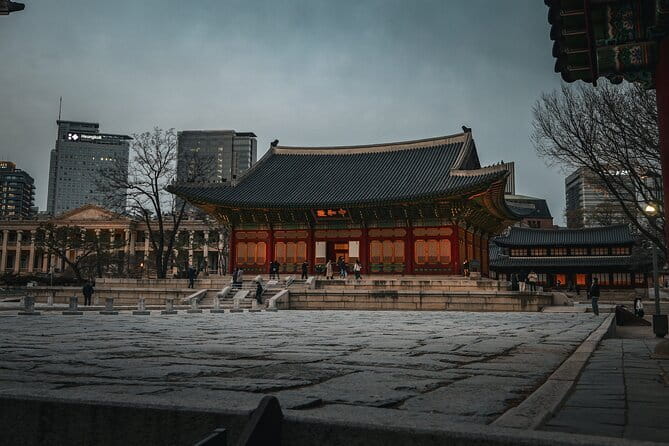
The former Russian Legation receives 20 minutes, one of the longer stops on the route. The guide explains why Korea’s penultimate monarch fled his palace in the middle of the night and remained here for a year.
That episode gives you a sharp picture of Korea’s uncertain position among foreign powers. A royal residence usually suggests control and security. This site tells a different story, one involving fear, diplomacy, and a monarch seeking protection away from his own palace.
Because the stop is longer than several others, the guide has more time to explain the setting and its political meaning. If you are especially interested in late Joseon Korea, imperial pressure, or the transition toward modern statehood, this will likely be one of the afternoon’s strongest sections.
Admiral Yi, King Sejong, and the national story in stone

At the statue of Admiral Yi Sun-sin, the guide explains how this general saved Korea and changed the course of world history. The wording is bold, but the subject deserves serious attention. Yi is one of Korea’s most important historical figures, and the statue is a central symbol in modern Seoul.
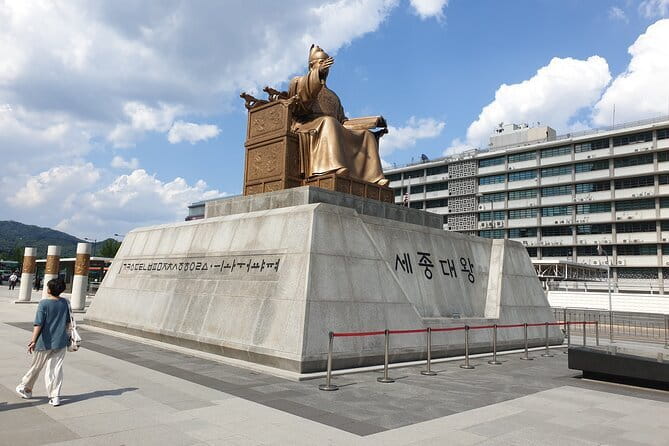
You then meet King Sejong the Great, considered the greatest Joseon king. The tour asks why, giving you more than a name and a date. King Sejong’s place in Korean memory comes through his leadership and the lasting effect of his policies and cultural work.
These two statues create a useful pairing. Yi represents military defense and national survival. Sejong represents royal leadership and intellectual progress. The stops take about 10 minutes each, so you get the main ideas without a long lecture.
The practical benefit is that the guide gives meaning to monuments you might otherwise photograph and pass. If you already know a great deal about either figure, the time may feel brief. For a first visit to Seoul, though, the explanations help you read the city’s public art with more understanding.
Gwanghwamun Square and the cost of democracy
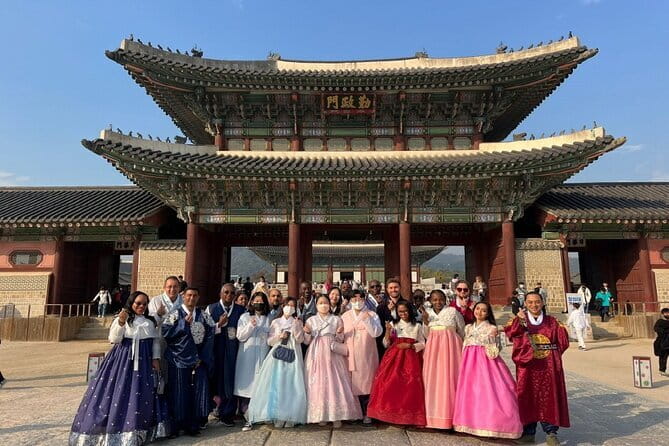
Gwanghwamun Square receives about 25 minutes, making it another major stop. The guiding question is direct: how many protests does it take to change a democracy?
This is where the tour’s modern political story comes together. Seoul is not presented only as an old royal capital that became a wealthy global city. You also learn about the struggle against dictatorship and the role of public protest in shaping South Korea’s political life.
The square is especially useful for this discussion because it is a public stage. The tour asks you to think about who gets to use such spaces, how citizens express political demands, and how change happens outside government offices.
The subject matter can be serious, but the format is grounded in a real place. You are not sitting in a classroom. You are standing in a square where public memory and present-day civic life meet.
Contemporary history, the Japanese Embassy, and an ongoing protest
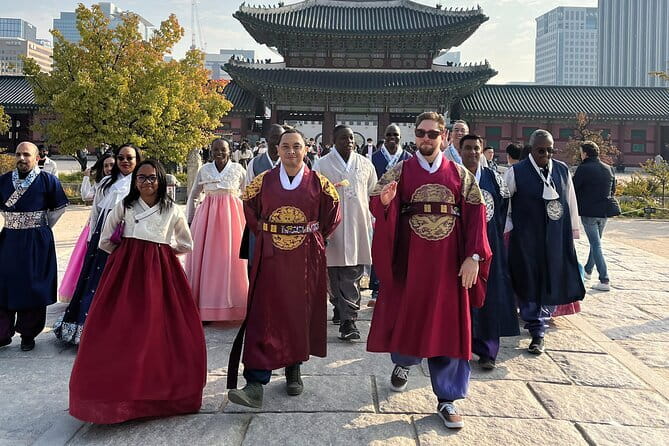
The National Museum of Korean Contemporary History is next, with about 15 minutes devoted to the view from its rooftop. You can see how much of Seoul’s central area is visible from above, and the stop gives the city’s recent past a physical setting.
The route then turns to the Embassy of Japan for about 10 minutes. The guide explains why this site is connected to the world’s longest-running protest. This is a difficult part of Korea’s modern relationship with Japan, and the stop gives you a chance to understand why historical memory remains active in public life.
The tour does not treat history as finished. Royal rule, occupation, war, dictatorship, and democracy are linked to places still used today. That is one of the strongest reasons to choose this experience over a tour that only covers palaces and traditional buildings.
Ending at Jogyesa Temple
The final stop is Jogyesa Temple, where you spend about 10 minutes learning how the ringing of bells connects people with the universe. It is a calm way to end an afternoon filled with political conflict and national struggle.
The temple also changes the tone of the route. You finish not with another government building or monument, but with a spiritual place and a sound-based idea of connection. The route ends directly up the street from where it began, and the guide can help with directions afterward.
Since the end point is near the start, you are not left in an unfamiliar part of Seoul. That is useful if you plan to continue sightseeing, find dinner, or return to your accommodation.
What the $26.60 price really covers
At $26.60 per person, the tour is priced below many long city excursions, but its value depends on what you want. You are not paying for admission to major attractions. The listed stops are free, and the experience does not include bottled water.
You are paying for a three-and-a-half-hour route with a small group, a guide who organizes the story, traditional Korean snacks, and an informative memento. The strongest value is the connection between places. Without a guide, you might see the bell, stream, statues, plaza, and temple as separate sights. Here, they form one historical route.
The snacks are a welcome extra, but bring water. The tour does not supply bottled water, and walking for several hours can make that omission noticeable.
The tour is booked around 81 days ahead on average. That suggests you should reserve early if your Seoul dates are fixed, especially since the group is capped at eight people.
Who should book this Seoul walk?
I would choose this tour if you want a clear introduction to Seoul’s central history and prefer discussion to a long list of dates. It suits first-time visitors, history-minded visitors, and anyone who wants to understand Korea’s modern democracy as well as its royal past.
It is also a good choice if you like small groups. The limit of eight people makes it easier to ask about a statue, building, or political event while you are standing in front of it. Eric is the guide name associated with the experience, so look for that information when booking if having a particular guide matters to you.
I would be more cautious if you want extended time inside museums or palaces. The route includes many stops, but several last only 5 or 10 minutes. You will see and discuss a lot without spending long periods at any one site.
The walk begins at Bosingak Bell Pavilion, 54 Jong-ro, Jongno District, at 2:30 pm. It ends at Jogyesa Temple. Service animals are allowed, the route is near public transportation, and most people can participate. Free cancellation is available until 24 hours before the start time. Changes or cancellations inside that window are not accepted for a refund.
Should you book it?
Book this walk if you want Seoul’s story told through real streets and public places, with equal attention to kings, foreign control, women’s education, protest, and religion. The small group and $26.60 price make it a sensible first-day or second-day orientation.
Skip it if your priority is a slow palace visit, extensive museum time, or a tour focused mainly on architecture. This is a brisk route with many short stops. For a compact, thoughtful introduction to how Seoul became modern Korea, though, it offers a lot for the time and money.
FAQ
How long does the Seoul History Walking Tour last?
The tour lasts approximately 3 hours and 30 minutes.
Where does the tour begin?
The meeting point is Bosingak Bell Pavilion at 54 Jong-ro, Jongno District, Seoul.
What time does the tour start?
The tour starts at 2:30 pm.
Where does the tour end?
The tour ends at Jogyesa Temple, directly up the street from the starting area. The guide can help with directions afterward.
How many people can join the tour?
The maximum group size is eight people.
Are food or drinks included?
Traditional Korean snacks and an informative memento are included. Bottled water is not included.
Can I cancel for a full refund?
Yes. You can cancel at least 24 hours before the experience start time for a full refund. Cancellations or changes made less than 24 hours before the start time are not accepted for a refund.
Just added around Seoul
- Your Personal Seoul Photographer!★ 4.1 · 15 reviews
- From Seoul: Hwacheon Ice Fishing and Lighting Festival Tour★ 4.5 · 4 reviews
- You’re Invited to Our Home in Seoul: The Only Cooking Class!★ 5.0 · 8 reviews
- Seoul: Gangneung BTS K-Pop & K-Drama Filming Locations Tour★ 4.6 · 14 reviews
- Unique Native Experience : Han River Picnic, Board game, BBQ★ 5.0 · 3 reviews
- 2-Hour Private Kayaking and Paddleboarding Experience in Hanriver★ 5.0 · 3 reviews
- Yun Korean Cooking Class in Seoul★ 5.0 · 6 reviews
- Day Trip to Yongin Daejanggeum and Korean Folk Village from Seoul★ 4.0 · 9 reviews
Seoul Walking Tours, compared.
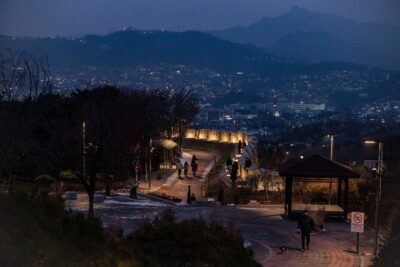
Seoul moonlight walking tour with local historian
Read our review →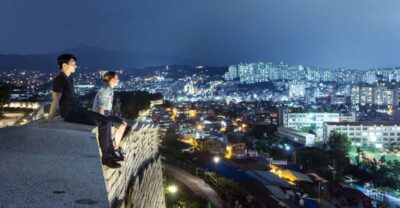
Evening Dark History, Folklore & Ghost Story Walking Tour
Read our review →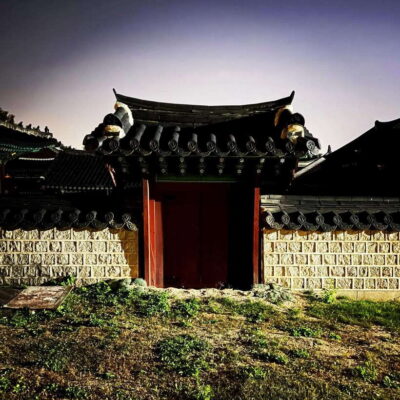
Dark Side of the City and Ghost Stories Walking Tour
Read our review →
Gangnam Walking Tour on Youth and Society in Seoul Korea
Read our review →
Gyeongbok Palace and Bukchon Hanok Walking Tour
Read our review →
Best Walking Tour to Gyeongbok Palace Bukchon Hanok Village
Read our review →
Highlights & Hidden Gems With Locals: Best of Seoul Private Walking Tour
Read our review →Browse the lists this tour appears in