
Reviewed · SEOUL WALKING TOURS
Seoul moonlight walking tour with local historian
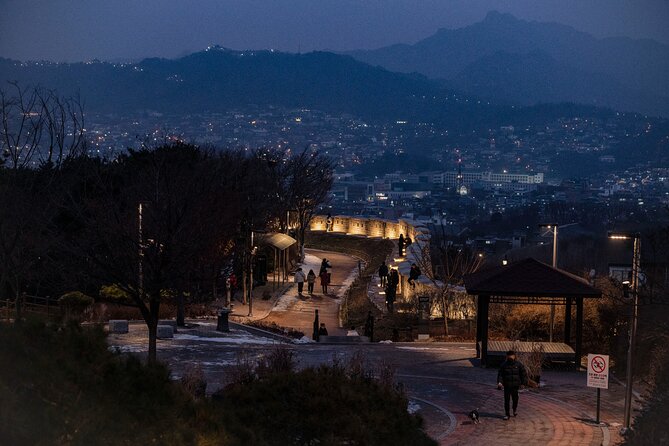
Seoul looks best from a hill after sunset, and this walk takes you from Hyehwa’s theater district to Ihwa Mural Village, Naksan Park, and the old city wall. Along the way, local guides such as Jessica, Ethan, June, and Smin connect the views with Korean history and present-day life.
I like the mix of local culture and big city views, especially the opening look at university life and the discussion of why hillside communities developed as they did. I also like that the route reaches places you might miss on a first Seoul visit. The main drawback is simple: this is a hill walk with stairs, so comfortable shoes and a fair level of fitness matter.
Key points to know before booking
- Two hours from Hyehwa to the city wall: The route covers five stops and returns to the starting point.
- A guide-led look at modern Korea: Expect discussion of university pressure, class, housing, local society, and Seoul’s changing identity.
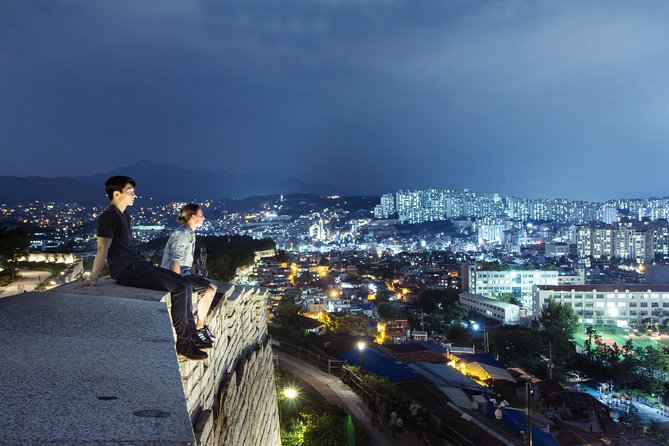
- The best views come after the uphill work: Naksan Park and Seoul City Wall provide the evening panorama.
- Several guides lead the tour: Jessica, Ethan, June, Smin, Sumin, Leah, and Shin are named in the feedback, so the tone may vary by date.
- Bring the right gear: Wear walking shoes, charge your phone, and consider bug spray.
- Good value at $31.98: The price covers a small-group cultural walk of up to 20 people, with no extra admission fees.
Why this Seoul night walk works so well
This is not simply a photo walk to a viewpoint. The route uses a few streets, parks, and old walls to explain how Seoul works.
You begin in Hyehwa, one of the city’s best areas for small theaters and student life. Then you climb toward Naksan and Ihwa, where the guide talks about education, social class, hillside housing, and the movement of Seoul’s capital through time. By the end, the city lights provide the show, but the commentary gives those lights some meaning.
I like that balance. You get a clear sightseeing reward, yet the walk does not treat Seoul as a collection of attractive backdrops. The guides talk about current Korean society as well as the past. Ethan, June, Jessica, Smin, and Sumin receive particularly strong praise for combining humor with useful explanations. Leah is described as friendly and relaxed, while Shin and Sumin are also singled out for clear, engaging tours.
Guide quality can vary, as it does on any multi-guide experience. One low rating points to a guide who struggled with English and storytelling. That is worth keeping in mind if you need polished interpretation throughout. The overall record is very strong, but the individual guide on your date will shape the evening.
More walking tours in Seoul:
- Seoul: Nighttime Hidden Gems Walking Tour
★ 5.0 · 775 reviews - Seoul: Evening Dark History, Folklore & Ghost Story Walking Tour
★ 5.0 · 593 reviews - Seoul: Dark Side of the City and Ghost Stories Walking Tour
★ 4.8 · 484 reviews
Starting in Hyehwa, where theater meets student life
The meeting point is at Hyehwa120 Daehak-ro in Jongno District. The area is close to public transportation, and the walk begins near Seoul University Hospital Medical Museum.
The first stop takes about ten minutes and has no admission charge. The subject is unusual: current university culture in Korea. The tour presents the nearby university setting as a way to discuss student life and the intense importance of education in Korean society.
This is a useful opening because it gives you a modern reference point before the tour moves into older Seoul. Education is not treated as an abstract topic. The guide connects it with social expectations and the pressure surrounding university entrance. Sumin is praised for explaining this part clearly, and other guides use humor to keep the subject from becoming too heavy.
You should not expect a long museum visit here. The stop is brief, and the focus is on the guide’s explanation rather than a full indoor program. Still, it helps you notice the area through a local lens.
Next comes Marronnier Park, a short five-minute stop. Hyehwa is known for live theaters and shows, so the park gives you a quick look at Seoul’s arts culture. You emerge from the subway area into streets filled with music, theater, and creative energy.
The stop is short, but it helps establish the neighborhood’s character. If you enjoy performance spaces and independent arts districts, this part adds something that a palace visit cannot. It also makes a pleasant contrast with the quieter uphill streets ahead.
Climbing Naksan Park, one step at a time
The route then heads toward Naksan Park. This is where the walk becomes more physical.
You will walk uphill and use stairs, though the exact effort depends on the group pace and the guide. Several comments call the route easy or manageable, while also warning that there are plenty of stairs. That is the honest reading: it is not a hard mountain hike, but it is not flat city sightseeing either.
Naksan Park is important for two reasons. First, it gives you a high view across Seoul. Second, it provides the setting for a story about how the capital was placed in Seoul and how the city changed around it.
The guide explains the relationship between the old capital, its defensive boundaries, and the modern city spreading beyond them. You are not just pointed toward distant towers and told to take a photo. The location becomes a way to understand why Seoul developed in this shape.
This is also one of the best places to ask questions. Guides such as Ethan and June are praised for answering patiently and for discussing both historic events and present-day life. If you want a lecture packed with dates, this may feel light. If you prefer a clear explanation that connects the past to the city you see around you, it should work well.
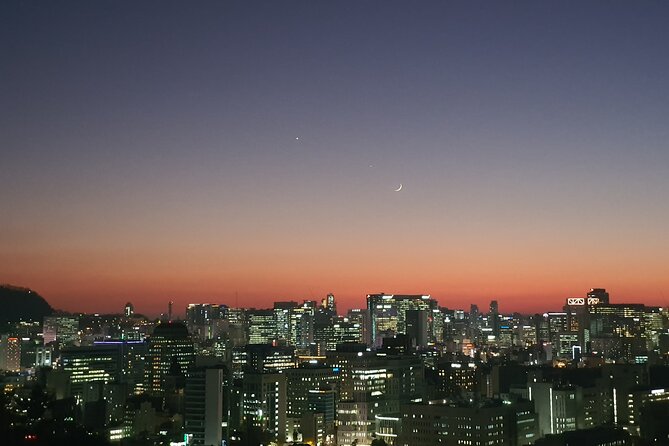
The timing is designed around sunset and night views. Depending on the season and start time, you may see the sky change before the lights take over. That gives you two moods in one walk, but the exact sunset experience depends on the date and weather.
Ihwa Mural Village and the social side of Seoul
Ihwa Mural Village receives about twenty minutes, making it one of the longer stops. It is known for painted walls and hillside streets, but the important part of the visit is the social story behind the neighborhood.
The guide explains that many hill communities in Seoul were home to people with fewer resources. That context matters. Without it, the village can look like a charming photo set. With it, you begin to see the steep streets, housing, and public art as part of a larger story about urban change and inequality.
The tour does not present Korean society as a smooth success story. It discusses socioeconomic problems, housing on hills, education, and the values that shape daily life. One particularly strong description of the experience highlights this frank approach to Korea today.
I appreciate that the walk gives you room to think about the people who live in these areas. Mural villages are residential neighborhoods, not outdoor theme parks. Keep your voice low, stay aware of doorways, and take photos with basic courtesy.
The art itself gives the tour visual variety. Bright walls and painted stairways break up the uphill route, while the guide’s context helps you look beyond the most photographed corners. You may find the village quieter and more reflective at night than during a busy daytime visit, though the available information does not promise a particular crowd level.
A different kind of day out around Seoul:
- Best DMZ Tour Korea from Seoul (Red Suspension Bridge Optional)
★ 5.0 · 41,422 reviews - DMZ Tour: 3rd Tunnel, Option(Suspension Bridge, Boat) from Seoul
★ 5.0 · 21,373 reviews - DMZ tour south Korea from Seoul (NK experience hall, defector)
★ 5.0 · 20,599 reviews - Seoul: DMZ Tour with Optional Suspension Bridge
★ 4.8 · 5,277 reviews
Walking the old Seoul City Wall after dark
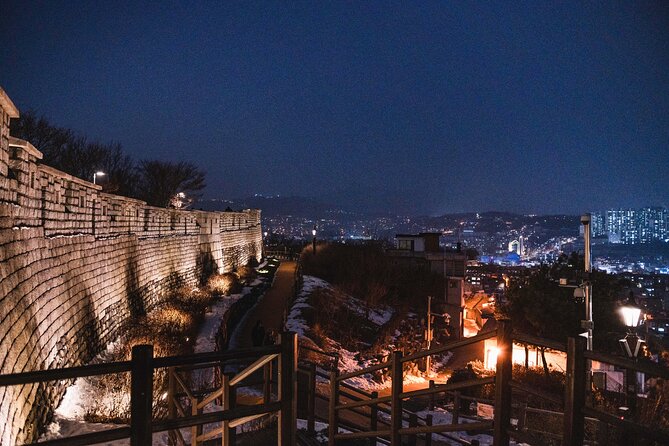
The final major stop is Seoul City Wall, a historic monument with one of the finest night views in this part of the city.
This is the payoff for the climb. From the wall and nearby high ground, Seoul opens below you in layers of lights. The route’s appeal is not just the view itself, but the way the wall frames the city. You can see old defensive architecture beside a modern capital that stretches far beyond it.
The walk has also gained interest from pop culture connections, including a location associated with K-Pop Demon Hunters. If that reference matters to you, it adds a modern touch. If it does not, the wall remains the main attraction.
This section is especially good for photographs, so charge your phone before you meet the group. One practical tip from the feedback is to bring bug spray. Evening insects may be an issue, particularly in warmer weather.
The guide usually stops to explain the wall and answer questions, rather than rushing you through. June is repeatedly praised for making the wall walk both informative and enjoyable. Ethan is noted for his calm humor and useful local suggestions. The relaxed pace also helps solo visitors meet people, since the tour is social without requiring you to arrive with a group.
What the two-hour format really gives you
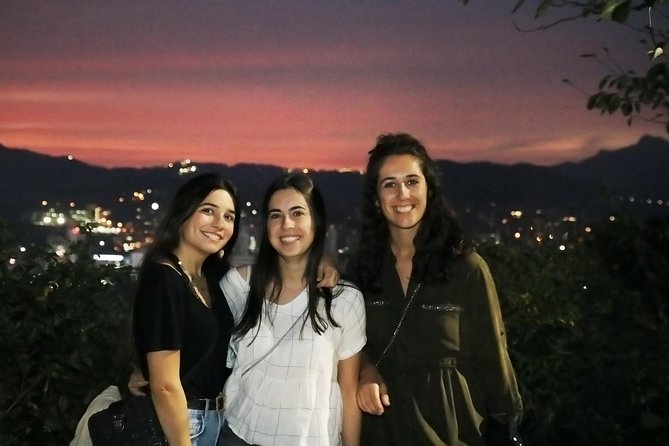
The published duration is about two hours. That is enough time to see the main points without turning the evening into a full endurance outing.
You should expect a steady progression: a brief introduction in Hyehwa, short cultural stops, a longer look at Ihwa, and more time for views near the wall. The route returns to the meeting point, which simplifies your evening plans. It does not leave you at an unfamiliar station or viewpoint.
The group can include up to 20 people. That is small enough for questions and guide interaction, though it is not a private tour. If everyone wants photographs at the same viewpoint, the group may need a little patience.
There is no special equipment or supplied gear. You provide the basics: comfortable shoes, water if you want it, a charged phone, and clothing suitable for an outdoor evening. The walk requires good weather. If poor weather cancels it, you can choose another date or receive a full refund.
After the walk, there is an optional food session. Dinner is not included in the $31.98 price, so treat it as a separate choice rather than part of the tour package. That can be useful if you want to continue talking with the group, but you are not paying for a meal you may not want.
Is $31.98 a fair price?
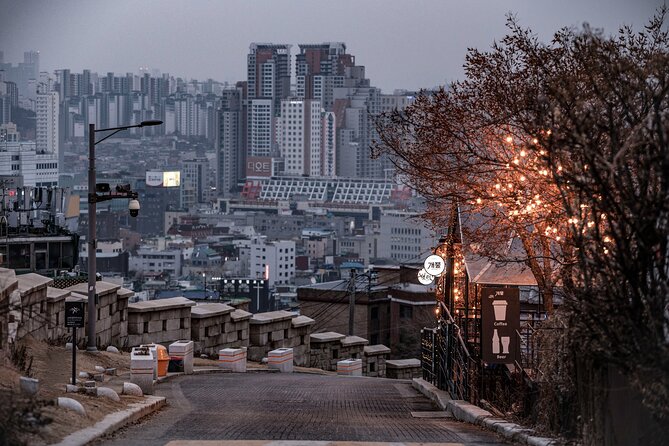
At $31.98 per person, this sits in a reasonable range for a guided Seoul experience lasting about two hours.
You are not paying admission fees, since all listed stops are free. The value comes from the route design and the explanation. You could walk through Naksan Park and Ihwa Mural Village on your own, but you might miss the social and historical links that make the neighborhoods more meaningful.
The price is strongest for first-time visitors, solo visitors, and anyone who wants help reading Seoul beyond its major palaces and shopping streets. It is less compelling if you already know the Hyehwa, Ihwa, and Naksan areas well or prefer to explore alone at your own pace.
The maximum group size of 20 keeps the cost below a private guide while still allowing direct contact with the host. Since the experience is mobile-ticket based and near public transportation, it is also easy to fit into a sightseeing schedule.
Which guide style might suit you
The guide names associated with this experience include Jessica, Ethan, June, Smin, Sumin, Leah, and Shin. You cannot assume every guide will teach in exactly the same style.
Jessica is repeatedly praised for humor, clear explanations, and an ability to make the history feel personal. Ethan is described as calm, funny, and strong on both history and current Korean culture. June receives praise for her detailed explanations and enthusiasm for Seoul’s past.
Smin and Sumin are noted for clear English, warmth, and useful explanations of education and social values. Leah is described as guiding the group in a friendly, companionable way. Shin is praised for being informed and engaging.
One poor experience involved weaker English and storytelling. That does not erase the strong overall pattern, but it is a fair caution. If your booking lets you see the guide’s name in advance, you may want to check the description carefully. If not, book this for the route and subject matter, not because you can guarantee one particular host.
Who should book this walk?
I would choose this tour for you if you want:
- A first-night orientation to Seoul’s northern central districts
- Evening views without arranging a private guide
- A useful introduction to Korean education and social pressures
- A route that mixes arts culture, hillside housing, murals, old walls, and city lights
- A social activity for solo visitors
- A guide who can answer questions about both history and daily life
I would hesitate if stairs are difficult for you, if you dislike uphill walks, or if you want a formal museum tour. The route includes hills and stairs, and the focus is conversation outdoors. It is also less suitable if you need a perfectly consistent guide presentation in polished English.
Should you book the Seoul moonlight walking tour?
Yes, if you want Seoul explained through neighborhoods rather than only through grand monuments.
The strongest part is the combination of context and scenery. You begin with university culture and theater streets, pass through a hillside community shaped by class and urban change, and finish beside the old city wall with Seoul shining below. That gives you a fuller sense of the capital than a viewpoint alone.
Book it for a clear evening, wear good shoes, charge your phone, and bring bug spray. If you are happy with a moderate uphill walk and an outdoor discussion, $31.98 is a fair price for two hours of local history, present-day insight, and one of Seoul’s most rewarding night views.
FAQ
How long is the Seoul moonlight walking tour?
The tour lasts approximately two hours.
Where does the tour start?
It starts at Hyehwa120 Daehak-ro in Jongno District, Seoul.
Where does the tour finish?
The activity ends back at the meeting point.
What places are visited?
The route includes Seoul University Hospital Medical Museum, Marronnier Park, Naksan Park, Ihwa Mural Village, and Seoul City Wall.
Are admission tickets included?
There are no admission fees for the listed stops, and no special supplies are needed for the walking tour.
Is the walk physically difficult?
The route includes uphill walking and many stairs. Comfortable shoes are recommended, and you should be confident walking in a hill environment.
Is dinner included?
No. An optional food session takes place after the tour, but its fee is not included.
What happens if the weather is poor?
The experience requires good weather. If it is canceled because of poor weather, you can receive a different date or a full refund. You can also cancel for a full refund up to 24 hours before the start time.
Just added around Seoul
- Your Personal Seoul Photographer!★ 4.1 · 15 reviews
- From Seoul: Hwacheon Ice Fishing and Lighting Festival Tour★ 4.5 · 4 reviews
- You’re Invited to Our Home in Seoul: The Only Cooking Class!★ 5.0 · 8 reviews
- Seoul: Gangneung BTS K-Pop & K-Drama Filming Locations Tour★ 4.6 · 14 reviews
- Unique Native Experience : Han River Picnic, Board game, BBQ★ 5.0 · 3 reviews
- 2-Hour Private Kayaking and Paddleboarding Experience in Hanriver★ 5.0 · 3 reviews
- Yun Korean Cooking Class in Seoul★ 5.0 · 6 reviews
- Day Trip to Yongin Daejanggeum and Korean Folk Village from Seoul★ 4.0 · 9 reviews
Seoul Walking Tours, compared.
Evening Dark History, Folklore & Ghost Story Walking Tour
Read our review →
Dark Side of the City and Ghost Stories Walking Tour
Read our review →
Gangnam Walking Tour on Youth and Society in Seoul Korea
Read our review →
Gyeongbok Palace and Bukchon Hanok Walking Tour
Read our review →
Best Walking Tour to Gyeongbok Palace Bukchon Hanok Village
Read our review →
Highlights & Hidden Gems With Locals: Best of Seoul Private Walking Tour
Read our review →
Street photoshoot and Seoul Hidden gem History Walking Tour
Read our review →Browse the lists this tour appears in