
Reviewed · GYEONGJU AND BUSAN MULTI-DAY TRIPS FROM SEOUL
Small Group 7D Korea package Tour with Seoul Gyeongju Busan Jeju
Korea packs a lot into this seven-day route, from Jeju’s volcanic coast to Seoul’s royal palaces and the tense border zone near North Korea. You fly between Seoul and Jeju, ride the KTX from Gyeongju, and leave the driving to a small group team capped at 15 people.
I like the wide mix of places and the practical handling of transfers. I also like the food angle: a cooking class, Gwangjang Market, local markets, and several included meals keep the trip from becoming a parade of photo stops. The main drawback is pace. Seven days for Jeju, Busan, Gyeongju, Seoul, and the DMZ means early starts, long drives, and little room to linger.
At a glance
- Jeju begins the trip: Beaches, lava formations, waterfalls, Seongsan Ilchulbong, and a folk village arrive in a busy first two days.
- Busan and Gyeongju show two sides of Korea: One is a lively port city, the other the former Silla capital filled with temples and royal tombs.
- The KTX saves valuable time: The bullet train carries you from Gyeongju to Seoul in about two hours.
- Food is part of the plan: You cook bibimbap, pancake, and soup, then explore Gwangjang Market with a food tour.
- The DMZ requires your passport: Expect an identity check, a tunnel visit, and a view toward North Korea from Dora Observatory.
- Several guides share the work: Guides named Jung, Jiyoung, Sang, Harry, Jones, and Clover are associated with different portions of the route.
A fast route through Korea, with the big sights included
At $1,988 per person, this is not a bargain-basement bus tour. But the price covers six nights in 3 to 4-star hotels, domestic air travel, the KTX, an air-conditioned vehicle, entrance fees, an English-speaking guide, four breakfasts, and seven lunches as listed in the inclusions.
That matters because Korea’s geography can make a short independent trip surprisingly fiddly. Jeju requires a flight, Busan and Gyeongju sit well south of Seoul, and the DMZ involves controlled access and a separate shuttle bus. Here, those moving parts are placed into one plan.
The tradeoff is personal freedom. You will not have much time to reshape the route around a favorite café, museum, or beach. The itinerary is described as flexible, but the number of stops means flexibility will usually involve small timing changes rather than dropping half a day of sightseeing.
The group maximum is 15. That is small enough for guides to help with questions and meals, though it is not the same as a private trip for two or four people. Different city guides may lead different sections. Jung is noted for combining historical background with current Korean politics, dramas, and K-pop, while Jiyoung, Sang, Harry, Jones, and Clover are also named among the guide team.
More Gyeongju and Busan trips from Seoul:
- 5-Day Korea Golden route by K-shuttle Tour from Seoul Including Busan, Yeosu
★ 4.5 · 37 reviews - Andong Hahoe Village [UNESCO site] Premium Private Tour from Seoul
★ 5.0 · 24 reviews - Danyang Tour:Guinsa Temple & Bobaljae & Cheongpung Cable Car
★ 5.0 · 15 reviews
Day 1: Jeju’s volcanic coast and eastern villages
Your trip begins with a morning arrival at Incheon Airport. A driver takes you to Gimpo Airport, where you catch a domestic flight to Jeju. That transfer is useful, but it also makes the first day dependent on your arrival time and airport movement. Pack your passport and keep your hand luggage organized.
The first stop is Woljeongri Beach, known for its sand, sea views, and café street. It is a pleasant introduction to Jeju, though one hour gives you enough time to look around rather than settle into the area.
At Gwangchigi Beach, black sand and volcanic scenery replace the usual pale shoreline. This is one of the more distinctive coastal stops because the beach reflects Jeju’s basalt geology. You then reach Seongsan Ilchulbong, or Sunrise Peak, a volcanic tuff cone formed by eruptions from the shallow sea about 5,000 years ago.
The visit to Seongsan is one of the day’s best opportunities for a walk. The schedule allows about an hour, so you should expect a limited climb rather than a full mountain outing. Shoes with a good grip will help.
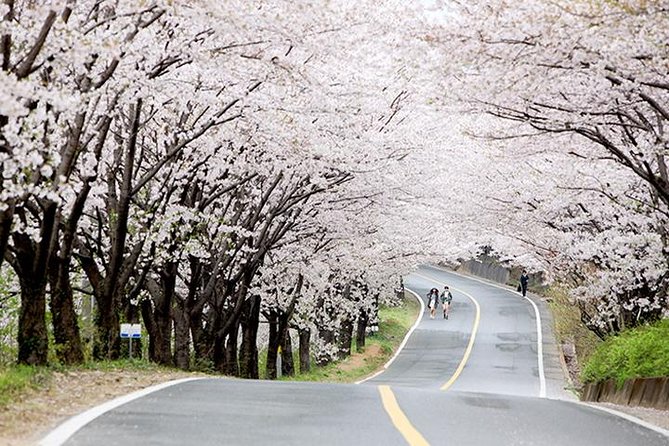
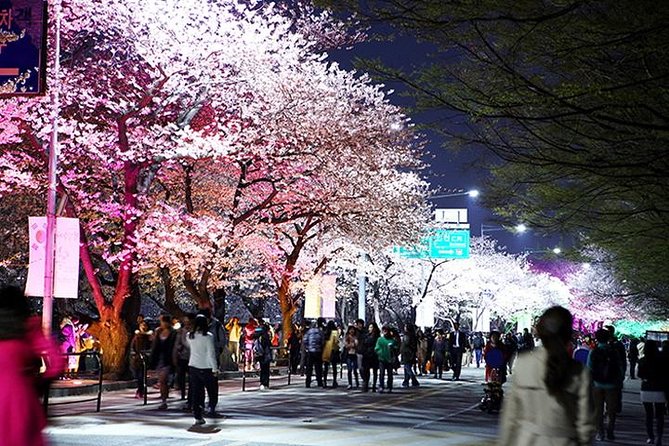
Seasonal scenery follows. The canola fields are associated with April through September in the schedule, while late March to early April may bring cherry blossoms along Noksan-Ro. Since flowers are weather-dependent, treat this as a seasonal bonus, not the main reason to book the trip.
Manjanggul Cave adds a different side of Jeju, showing the island’s volcanic past underground. The visit is only 30 minutes, so it is a quick look rather than a long cave walk.
The day ends at Seongeup Folk Village, where traditional Jeju houses and local ways of life are presented. Half an hour is brief, but the stop helps balance the beaches and geological sites with human history.
This is an ambitious first day. You get a strong Jeju sampler, but the sequence can feel rushed after an international arrival and domestic flight.
Day 2: Hallasan, waterfalls, and Jeju’s light-filled art
Day two begins with the Jeju National University area, especially Jeonong-Ro, a noted cherry blossom location around April 7 to 10. The exact bloom dates change, so the stop will be most rewarding in the right season.
A brief stop also covers the so-called mysterious road, where objects appear to roll uphill. The effect is an optical illusion, a quick roadside curiosity rather than a major attraction.
Hallasan National Park follows. Hallasan rises to 1,950 meters and is South Korea’s highest mountain, a dormant volcano made mainly of basalt. The schedule gives you about two hours here. That is enough for a selected walk and mountain scenery, not a summit hike.
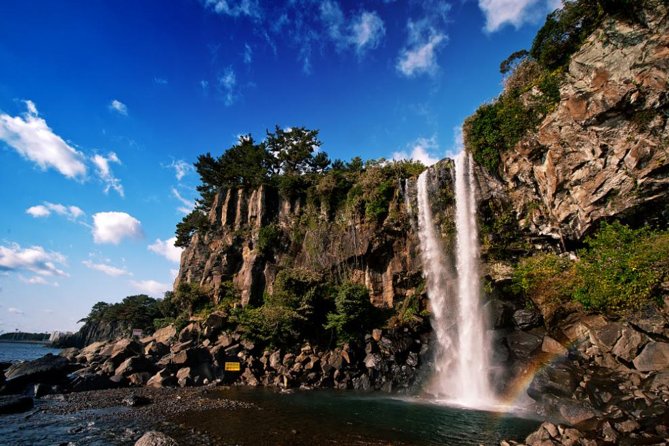
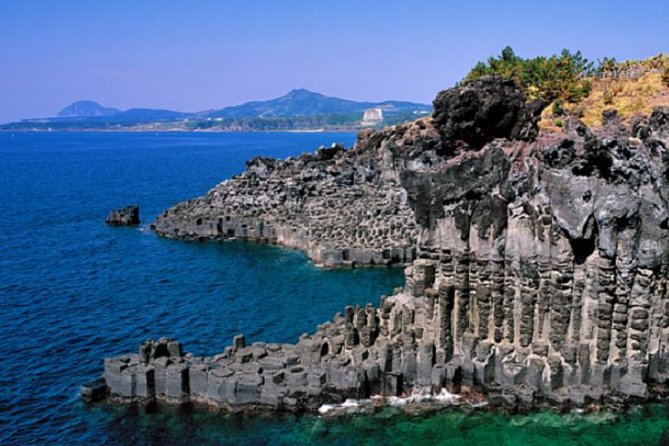
You also visit a coastal area with black rock pillars shaped into cubes and hexagons. These formations show the sharp geometry created by cooling volcanic rock. Cheonjiyeon Falls and Jeongbang Waterfall add water to the day. Jeongbang is especially unusual because it drops directly into the ocean, a feature identified here as unique in Asia.
The final major stop is Arte Museum Jeju, an indoor exhibition of light and video art. It gives you a change of pace after two days of beaches, hills, and waterfalls. It is also useful if weather affects outdoor sightseeing.
The schedule includes several short stops, so you should expect a full day in a vehicle with frequent exits. I would wear comfortable shoes and carry a light rain layer, especially if your visit includes Hallasan and waterfalls.
Day 3: Busan markets, temples, and the sea
You leave Jeju by air and continue to Busan. The exact transfer details are not spelled out in the schedule, but the domestic flight and vehicle transport are part of the package structure.
Haeundae Dalmaji-gil Road opens the Busan portion. The road runs beyond Haeundae Beach and is known for pine trees, sea views, and cherry blossoms. The listed 20-minute stop is mainly for a quick view and photographs.
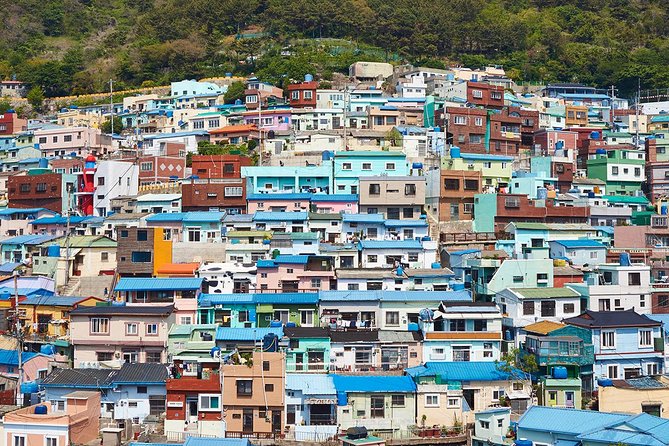
Gamcheon Culture Village is more substantial. Built in a staircase pattern on a coastal hillside, it began as a settlement for war refugees and later became one of Busan’s best-known cultural areas. Expect slopes, steps, and tight lanes. The one-hour visit gives you time to see the layout, but not to explore every corner.
Jagalchi Market brings you into Busan’s seafood culture. The market is famous for fresh fish and seafood stalls, with the option in the area to buy and eat seafood. Your guide can help explain what you are seeing, but personal food purchases are not included.
Nearby BIFF Square is tied to the Busan International Film Festival and is also a street-food area. Gukje Market follows, with stalls selling new and used goods. Together, these stops show Busan as a working port city shaped by war, migration, trade, film, and food.
Haedong Yonggungsa is one of the trip’s most memorable religious sites. Unlike many Korean temples located in the hills, this one is associated with the coast. The hour-long visit gives you time to see the temple setting and sea views.
The day ends at Haeundae Blue Line Park, where a train offers views along the Busan shoreline. This attraction includes an admission ticket, but the schedule does not specify which train service or exact ride length is used. Ask your guide how the timing works on your date.
Busan’s day has a clear theme: food, neighborhoods, coast, and city culture. It is less about quiet contemplation and more about seeing several faces of a major Korean city.
A different kind of day out around Seoul:
- Best DMZ Tour Korea from Seoul (Red Suspension Bridge Optional)
★ 5.0 · 41,422 reviews - DMZ Tour: 3rd Tunnel, Option(Suspension Bridge, Boat) from Seoul
★ 5.0 · 21,373 reviews - DMZ tour south Korea from Seoul (NK experience hall, defector)
★ 5.0 · 20,599 reviews - Seoul: DMZ Tour with Optional Suspension Bridge
★ 4.8 · 5,277 reviews
Day 4: Silla treasures in Gyeongju, then Seoul by KTX
A roughly one-hour drive takes you from Busan to Gyeongju. This was the center of the Silla kingdom, and the day shifts from modern port life to ancient royal sites.
Bulguksa Temple is the main historic stop. It is a UNESCO World Heritage site and one of Korea’s most important temple complexes. The hour here is enough to see the major gates, terraces, and stone features, though a history-minded visitor may wish for more time.
Seokguram sits on Tohamsan Mountain and contains a famous stone Buddha in a grotto. The site has been preserved for more than 1,200 years, partly through its ventilation design. The setting and sculpture are the point, so listen closely when your guide explains how the grotto was built.
Bomun Lake Tourism Complex provides a more open break. In April, cherry blossoms line the walkway. The area is arranged for tourism, so it feels less old-world than Bulguksa or the tomb district, but it gives you a chance to stretch your legs.
Daereungwon Tomb Complex contains huge grass-covered royal burial mounds. At Cheonmachong Tomb, you can enter the tomb itself and see how these burial sites were constructed. Gyeongju Gyochon Traditional Village adds noble-style houses and a more domestic view of the old city.
Donggung Palace and Wolji Pond is scheduled for evening, when the pavilions and water create one of Gyeongju’s best-known night scenes. The 40-minute visit is short, but the timing is well chosen.
From Gyeongju Station, you board the KTX to Seoul. The ride takes about two hours. This is an efficient finish to a long sightseeing day, though one practical point deserves attention: you may need help finding the right platform and train. One person specifically wished for more assistance at the station, so ask your guide clearly about the boarding process before leaving the group.
Day 5: Korean cooking and Seoul’s younger side
The cooking class lasts about three hours and covers three Korean dishes: bibimbap, traditional pancake, and soup. The menu can change by season. This is one of the tour’s strongest features because you do more than watch a demonstration. You get a practical introduction to familiar Korean food and can ask questions about ingredients and preparation.
Vegetarian meals are available if requested at booking. Do not wait until the cooking class begins to mention dietary needs.
After lunch or the class schedule, you visit Hongdae. This is Seoul’s youthful district, with shops, food, street performances, and a creative student feel. The scheduled hour lets you sample the area, but it will not cover every side street.
Nanta at Myeongdong Theater is optional. It is a nonverbal performance built around kitchen action, rhythm, and physical comedy. Prices are listed at $35 for S seats, $45 for P seats, and $55 for V seats. Since the show is not included, decide based on your energy and interest after several busy days.
The choice here is useful. You can add a popular Seoul performance, or use the evening for your own time in the city.
Day 6: Palaces, markets, and Seoul after dark
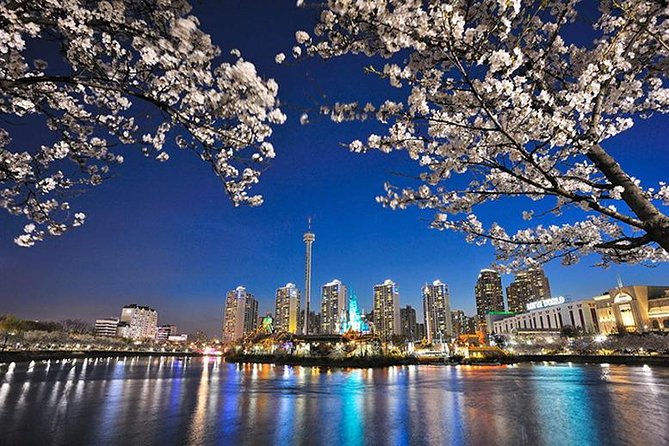
Yeouido Park begins the day, especially appealing during cherry blossom season. The park sits on an island in the Han River and changes character in spring, when the trees become the focus.
Gyeongbokgung Palace is the grand historical centerpiece. Built in 1395 as the first and largest palace of the Joseon Dynasty, it gives you a clear introduction to royal Seoul. An hour is enough for the main spaces and some explanation, though not for every building.
Jogyesa Temple offers a quieter city-center stop. It is an important Buddhist temple with lectures, rituals, and a decorated garden. The contrast with the palace helps you see that Seoul’s historic life is not limited to royal buildings.
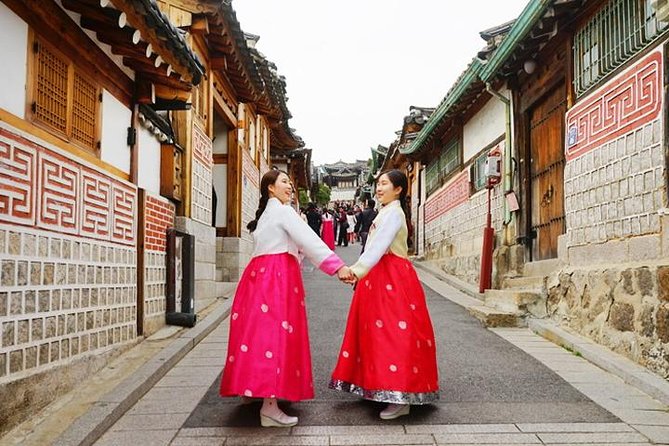
Bukchon Hanok Village is listed between the temple and market stops. Its narrow lanes and traditional hanok houses are attractive, but remember that this is also a residential area. Keep voices low and follow local instructions.
Gwangjang Market is the food-tour stop. It was Korea’s first permanent market and is now famous for traditional snacks and dishes. This is a good place to ask your guide what to try rather than ordering at random. Personal purchases may be extra, so carry some spending money.
N Seoul Tower provides a wide view over the city from Namsan Mountain. The tower’s top reaches nearly 480 meters above sea level when the mountain and tower are counted together. After sunset, Myeongdong brings cosmetics, clothing, shoes, department stores, and street food.
Insadong finishes the day with tea houses, antiques, art shops, souvenirs, traditional restaurants, and Korean sweets. The route is crowded with stops, so you may feel ready for a quiet evening by the end.
Day 7: The DMZ and a final suspension bridge
The last day heads north to Imjingak Pyeonghoa-Nuri Park. This is where you stop to obtain DMZ shuttle bus tickets and enter the controlled area. Bring your passport. An identity check is required, and you cannot treat this portion like an ordinary sightseeing district.
The Third Tunnel is the first major DMZ stop. North Korea dug the tunnel after the Korean War, and you can enter part of the actual passage. The tunnel is a serious historical site, not simply a photo stop, and the walking conditions may feel confined.
At Dora Observatory, you can look toward North Korea from one of the northernmost public viewpoints in South Korea. Visibility depends on conditions, so the value lies in the viewpoint and the border context, not a guaranteed clear view.
Tongilchonan-gil is the final DMZ stop, with souvenirs and local products. The village sits within the civilian control zone and operates under a curfew. The schedule allows only 15 minutes.
Gamaksan Chulleong Bridge ends the tour. A roughly 10-minute hike leads to a suspension bridge and views over an area connected to Korean War battles. It is a pleasant final outdoor stop, but the tour is not over until this visit is complete.
After day seven, you can return home directly or remain in Seoul for extra personal time. The package itself does not include extra nights.
The value of $1,988
The price makes the most sense if you value saved planning time. Domestic flights, KTX rail, hotel nights, entrances, vehicles, guides, and many meals are bundled together. Recreating this route independently would require careful coordination between airports, train stations, city transfers, and the DMZ shuttle system.
It is less compelling if you prefer slow travel, boutique hotels, or choosing your own restaurants. The hotels are described as clean 3 to 4-star properties, but individual hotel names are not provided. Dinner coverage is also not clearly included, so budget for evening meals and personal spending.
The package is rated 4.7 out of 5 from 13 ratings, with 100 percent recommending it. The strongest praise centers on organization, smooth transfers, friendly guides, useful food advice, and the ability to see sites that would be difficult to arrange in one week. Guides such as Jung and Sang receive particular appreciation for historical context, energy, and care with different abilities in the group.
Who should book this route?
I would choose this tour if you have only one week, want Korea’s major regions, and prefer a guide to handle transportation. It suits first-time visitors who want context at temples, markets, palaces, and the DMZ rather than simply collecting photos.
You should think twice if you need unhurried mornings, long meals, or several free afternoons. The pace is demanding, and the first day begins with an airport transfer and flight before the sightseeing really gets going.
The booking is non-refundable and cannot be changed after purchase. That makes travel insurance and firm date planning sensible. The tour also requires a minimum number of participants, though a full refund or alternate option is offered if the operator cancels for that reason.
FAQ
How long is the Korea package tour?
The tour lasts approximately seven days and includes six nights of accommodation.
Which destinations are included?
The route covers Jeju, Busan, Gyeongju, Seoul, and the DMZ area near the North Korean border.
Is transportation included?
Yes. The package includes a domestic flight, the KTX bullet train from Gyeongju to Seoul, and an air-conditioned tour vehicle.
How large is the group?
The activity has a maximum of 15 participants. It is described as a small group tour, with an itinerary that can be flexible.
Are meals included?
The listed inclusions cover four breakfasts and seven lunches. Personal expenses are not included, and you should confirm dinner arrangements before booking.
Do I need my passport for the DMZ?
Yes. You need your passport because an identity check is required before entering the civilian control zone.
Just added around Seoul
- Your Personal Seoul Photographer!★ 4.1 · 15 reviews
- From Seoul: Hwacheon Ice Fishing and Lighting Festival Tour★ 4.5 · 4 reviews
- You’re Invited to Our Home in Seoul: The Only Cooking Class!★ 5.0 · 8 reviews
- Seoul: Gangneung BTS K-Pop & K-Drama Filming Locations Tour★ 4.6 · 14 reviews
- Unique Native Experience : Han River Picnic, Board game, BBQ★ 5.0 · 3 reviews
- 2-Hour Private Kayaking and Paddleboarding Experience in Hanriver★ 5.0 · 3 reviews
- Yun Korean Cooking Class in Seoul★ 5.0 · 6 reviews
- Day Trip to Yongin Daejanggeum and Korean Folk Village from Seoul★ 4.0 · 9 reviews
Gyeongju and Busan Multi-Day Trips from Seoul, compared.
5-Day Korea Golden route by K-shuttle Tour from Seoul Including Busan, Yeosu
Read our review →![Andong Hahoe Village [UNESCO site] Premium Private Tour from Seoul](https://i.seoultourreviews.com/wp-content/uploads/andong-hahoe-village-unesco-site-premium-private-tour-from-seoul-400x267.jpg)
Andong Hahoe Village [UNESCO site] Premium Private Tour from Seoul
Read our review →
Danyang Tour:Guinsa Temple & Bobaljae & Cheongpung Cable Car
Read our review →![3-Days 2-Nights Gyeongju UNESCO Sites & Busan City [Private Tour from Seoul]](https://i.seoultourreviews.com/wp-content/uploads/3-days-2-nights-gyeongju-unesco-sites-busan-city-private-tour-from-seoul-400x267.jpg)
3-Days 2-Nights Gyeongju UNESCO Sites & Busan City [Private Tour from Seoul]
Read our review →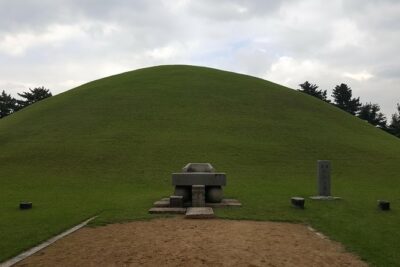
Gyeongju UNESCO Sites Tour by KTX train; The Museum Without walls
Read our review →
![Andong Hahoe Folk Village [UNESCO World Heritage] Private Tour from Seoul](https://i.seoultourreviews.com/wp-content/uploads/andong-hahoe-folk-village-unesco-world-heritage-private-tour-from-seoul-400x266.jpg)
Andong Hahoe Folk Village [UNESCO World Heritage] Private Tour from Seoul
Read our review →
Browse the lists this tour appears in