
Reviewed · SEOUL TRADITIONAL MARKET TOURS
Seoul: Korean Cooking Class at a Local Home and Market Tour
Seoul’s best food lessons often begin before the stove is turned on. This experience starts at Mangwon Station with a walk through a local market, where you taste street food, learn about Korean ingredients, and shop for the dishes you will later cook in a local home. The market-to-kitchen flow gives the class a useful sense of place.
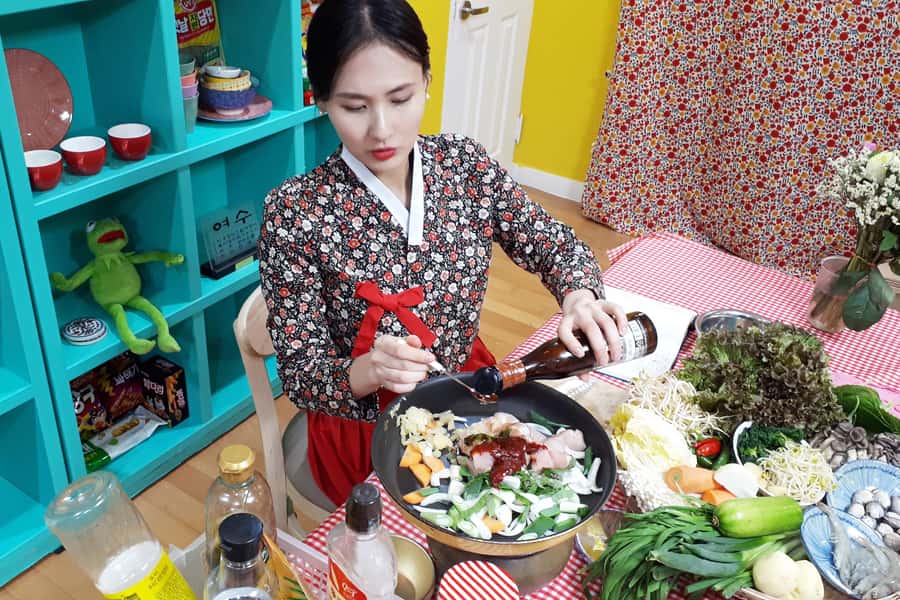
I like the hands-on format, since you prepare bibimbap, dakgalbi, haemul-pajeon, and doenjang-jjigae rather than simply watching a demonstration. I also like the generous meal that follows, with a traditional Hanjeongsik spread of more than 10 side dishes, seasonal fruit, rice wine, and rice.
The main consideration is the pace. Three and a half hours goes quickly, and the class takes place in a local home with no elevator. You need to make your own way to Mangwon Station, and anyone with allergies or dietary restrictions should contact the host before booking.
Key points at a glance
- Mangwon market comes first: Shop for ingredients, sample street food, and get a look at everyday Korean food shopping away from the major tourist sights.
- Four dishes are cooked: The menu includes bibimbap, dakgalbi, haemul-pajeon, and doenjang-jjigae.
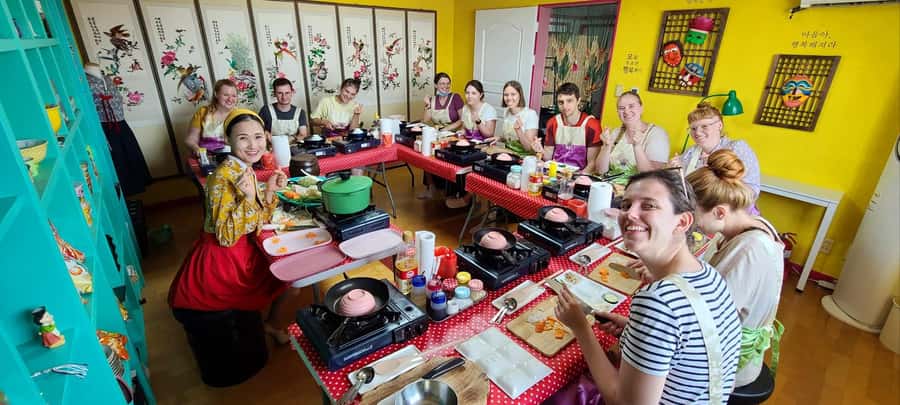
- The class is genuinely hands-on: You receive ingredients and equipment, and even first-time cooks can follow the step-by-step instruction.
- The meal is bigger than the cooking: Your host provides a Hanjeongsik meal with more than 10 side dishes, fruit, rice, and rice wine.
- Small groups help: The class is limited to 10 people, with English and Korean instruction.
- There are cultural extras: You learn basic Korean phrases and can try on a Tal mask associated with Korean heritage festivals.
Starting at Mangwon Station and entering local Seoul
Your meeting point is outside exit 2 at Mangwon Station. There is no hotel pickup, so plan your route in advance and allow a little extra time. The activity ends back at the same meeting point, making it easier to fit into a day of sightseeing in western Seoul.
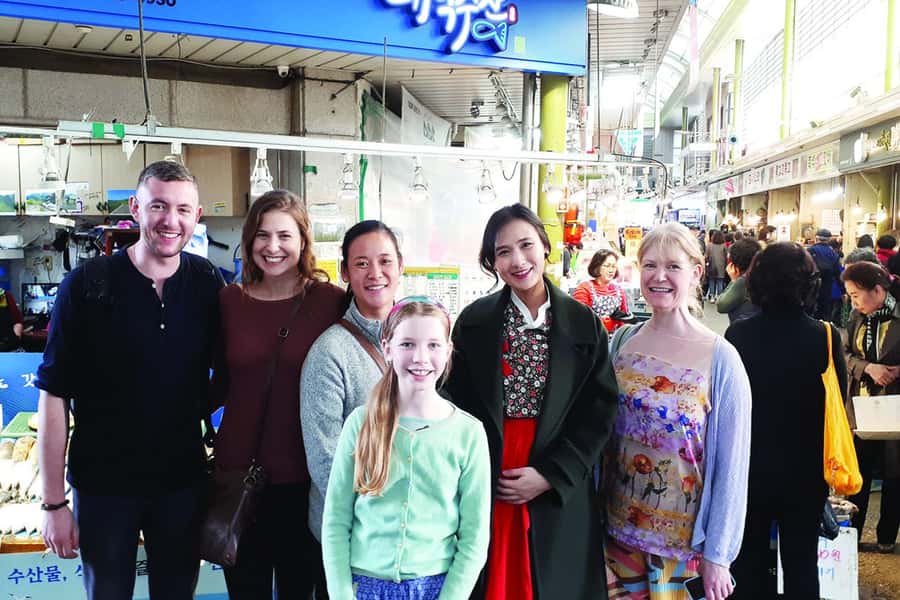
The first walk takes you into a traditional local market. The setting matters. Instead of meeting your chef in a classroom and beginning with premeasured ingredients, you see the foods in the place where people buy them. Your guide points out vegetables, seafood, sauces, and other items needed for the cooking session.
The market is described as less touristy than Seoul’s best-known food markets. That does not mean it is quiet or staged. You should expect a working neighborhood market, with stalls, food displays, and plenty to look at. The exact street-food samples can vary, since the menu depends on what is available that day.
Some visitors refer to this walk as the Mangwon and World Cup market area. It is a useful introduction to Korean food culture because ingredients stop being anonymous objects in a recipe. You can connect the seafood in the market to the pancake you will make later, or see the produce that becomes part of your bibimbap.
The walk also gives you an easy way to ask questions. Your English-speaking host can explain unfamiliar ingredients and point out things you might otherwise miss. That is especially helpful if this is your first visit to Korea or if you want to shop for Korean ingredients after the tour.
More Korean cooking classes in Seoul:
- Local Home Korean Cooking Class & Market Adventure in Seoul
★ 5.0 · 1,024 reviews - Master Korean traditional cooking with a Kimchi chef
★ 5.0 · 385 reviews - Seoul: Korean Cooking at Seoul Cooking Club!
★ 5.0 · 311 reviews
Street-food tasting before the cooking begins
Street-food samples are included, so you get a taste of the market before sitting down to cook. This is a small part of the activity, but it helps you understand the contrast between quick market food and a carefully arranged home meal.
Keep in mind that the tastings are samples, not a separate food tour. If you arrive hungry, you will still have the main meal later, but you should not expect a full market lunch at this stage. The real feast comes after the class.
Your guide also teaches a few Korean phrases during the experience. This is not a formal language lesson, but it adds a pleasant social touch. Even a handful of useful words can make the market walk feel more connected to the place, rather than simply a tour of food stalls.
Cooking four Korean dishes in a local home
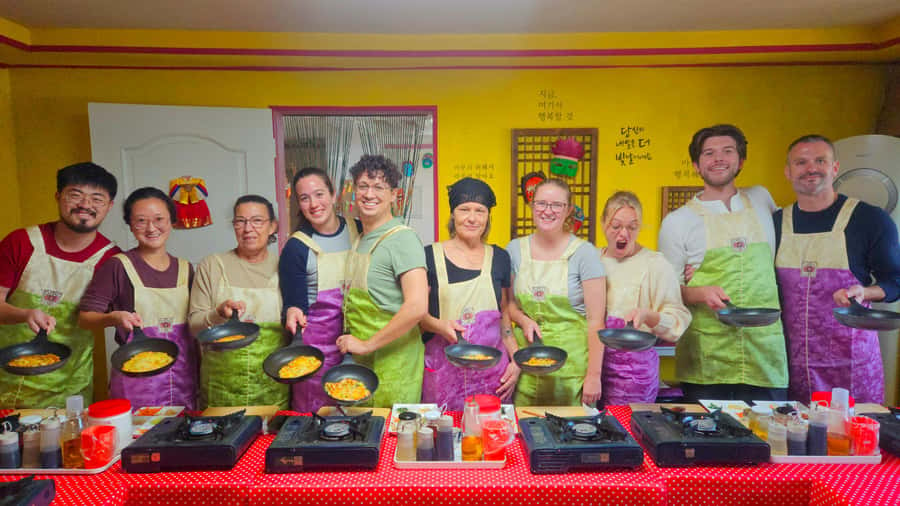
After the market, you head to the host’s home for the cooking session. The home setting is one of the most personal parts of the activity. It gives you a glimpse of a Korean domestic space, and the decoration has been described as colorful and Korean in character.
The class menu covers several different cooking methods and flavors:
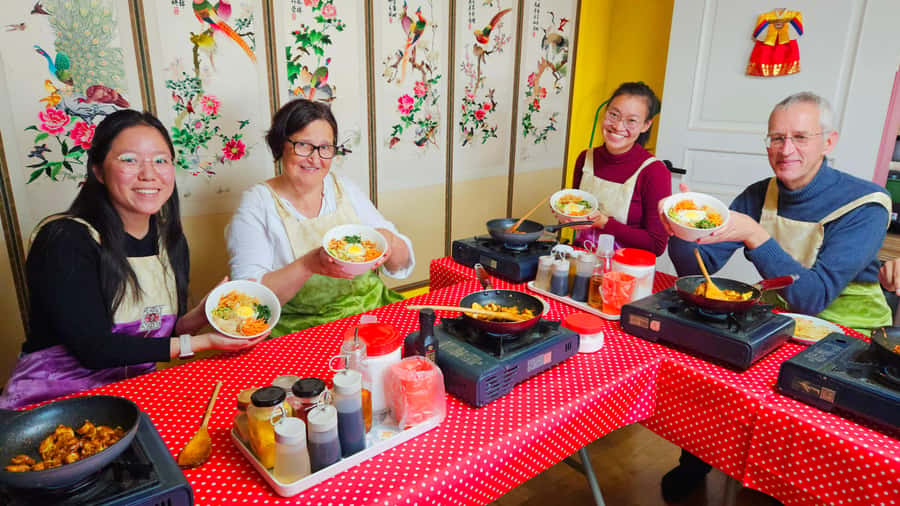
- Bibimbap: Mixed rice with meat and vegetables, assembled so that separate ingredients come together in one bowl.
- Dakgalbi: Stir-fried chicken with the bold seasoning associated with this popular Korean dish.
- Haemul-pajeon: A seafood and green onion pancake, including the fun challenge of cooking and flipping the batter.
- Doenjang-jjigae: A fermented soybean paste stew with a savory, earthy flavor.
This is a smart menu for a short class. Bibimbap shows how Korean meals combine rice, vegetables, and seasoned toppings. Dakgalbi introduces a hot stir-fry. Pajeon gives you a hands-on pancake technique, and doenjang-jjigae explains why fermented soybean paste is so important in Korean home cooking.
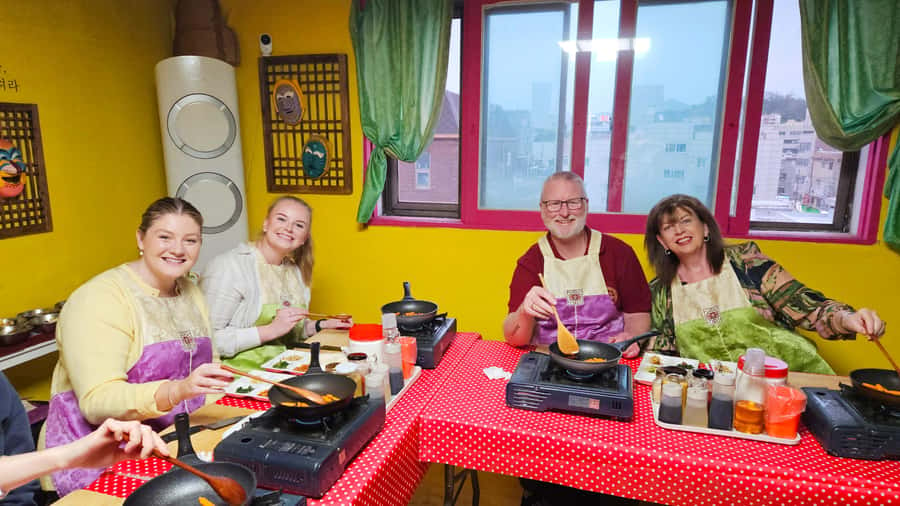
You are not simply watching the host cook. The format gives participants their own cooking space, and the instructor explains each step in detail. That makes the activity suitable for beginners, including people who do not usually cook. At the same time, anyone already comfortable in the kitchen can pay attention to seasoning, preparation, and presentation.
The hosts named in the experience include Sarah, Sara, and Junghee. The most useful quality to look for is not a particular cooking style, but the personal instruction. Sarah and Sara are described as energetic, organized, and confident in English, while Junghee is warm, funny, and welcoming. The tone appears to be friendly without forcing everyone to perform for the group.
The class is limited to 10 participants. That is large enough for a social meal but small enough for the host to interact with each person. A cooking class can become frustrating when you are stuck at the back of a demonstration. Here, the small-group format and individual work areas reduce that risk.
A Hanjeongsik meal with more than 10 side dishes
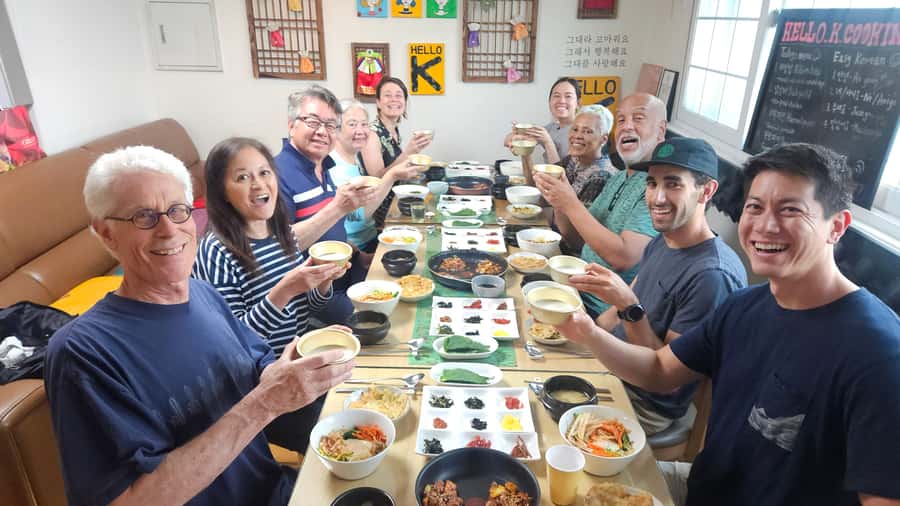
Once the cooking is finished, you sit down to eat. Your dishes form the core of the meal, but the host also provides a Hanjeongsik-style spread with more than 10 side dishes, rice, seasonal fruit, and rice wine.
Hanjeongsik is less about one large centerpiece and more about variety. The many small dishes let you compare different flavors and textures alongside rice and the main dishes. This makes the meal a useful lesson in how Korean food is served at home, where side dishes can be as important to the table as the main course.
This is also where the experience offers more value than a basic cooking lesson. At $98 per person, the price is not cheap if you judge it only by the number of recipes. But the fee covers a market visit, street-food samples, a chef-led class, ingredients, equipment, a substantial meal, drinks, recipes, and photo and video service.
You are paying for time with a local host as well as food. If you want only a quick recipe demonstration, a less expensive class may suit you better. If you want the market context, personal instruction, and a sit-down meal that continues the cultural lesson, the price is easier to justify.
Rice wine is included, along with water and a welcome tea. If you do not drink alcohol, the rice wine is only one part of the meal, not the focus of the activity. The important point is that the food and drink are built into the experience, so you do not need to budget separately for lunch afterward.
More traditional market tours in Seoul:
- Seoul: Gyeongbok Palace, Bukchon Village, and Gwangjang Tour
★ 4.9 · 2,321 reviews - Seoul Street Food Market Tour
★ 5.0 · 1,226 reviews - DMZ Tour Seoul to North Korea’s 3rd Tunnel & Majang Lake Crossing
★ 5.0 · 1,185 reviews - Seoul: Gyeongbok Palace, Bukchon Village, and Gwangjang Tour
★ 5.0 · 1,044 reviews
Tal masks and small cultural details
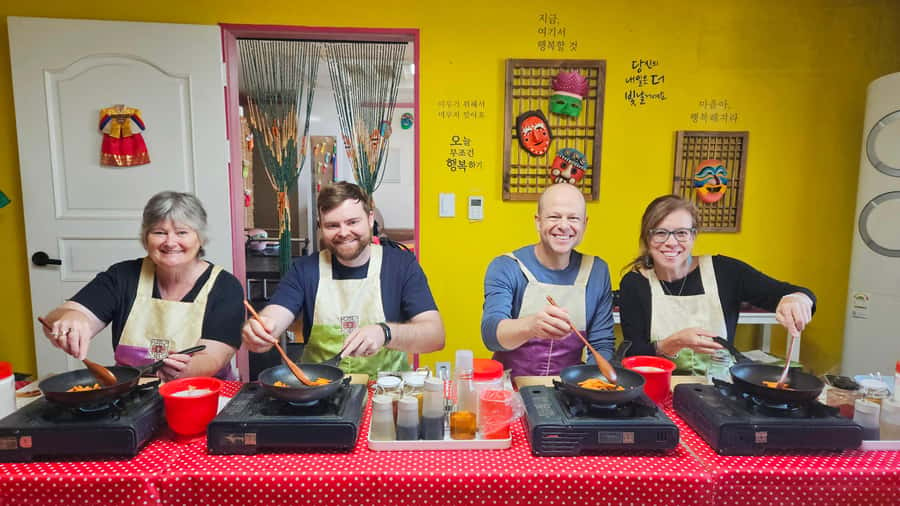
The cooking is the main event, but the class includes a few extra cultural touches. You can try on an artful Tal mask, the type associated with Korean heritage festivals. It is a quick activity, yet it gives the day something beyond food.
The mask experience works best as a light cultural introduction rather than a full lesson in Korean mask traditions. You should not book this expecting an extended performance or museum-style presentation. Instead, it is one of several small details that make the home visit feel more connected to Korean customs.
The welcome tea and Korean phrases serve a similar purpose. None takes up much time, but together they give the class a social rhythm: meet at the station, walk and taste, cook, eat, talk, and finish with a few memories to take home.
Recipes, photos, and what you take home
Recipes are included, so you can try the dishes again after returning home. This is important because Korean cooking often depends on several ingredients that may be unfamiliar at first. Having the recipe helps you remember the order of preparation and the basic balance of flavors.
The experience also includes photo and video service. That means you can focus on cooking and talking instead of constantly reaching for your phone. The exact format of the photos or videos is not specified, so treat this as a useful extra rather than the main reason to book.
One practical point is worth noting: at least one person would have preferred a small printed cookbook as a keepsake, with recipes instead sent through WhatsApp. If you like collecting paper mementos, bring a notebook or ask how the recipes will be delivered. Digital recipes are convenient, but they are less charming than a small booklet.
Timing, access, and planning your day
The activity lasts about three and a half hours. That is enough time for the market, samples, cooking, and meal, but not enough for a leisurely full-day food tour. Check the available starting times when booking and keep the rest of your schedule flexible.
Because the class ends at Mangwon Station, you can combine it with other plans in Seoul. Still, do not schedule a major appointment immediately afterward. Market walks can take time, and the meal is meant to be enjoyed rather than rushed.
The local home does not have an elevator. You should be comfortable using stairs to reach the venue. This is the most important access detail provided, especially for anyone with limited mobility or heavy luggage.
There is no hotel pickup or drop-off. You are responsible for getting to and from Mangwon Station. The meeting point is clear, but Seoul’s transit system can still take time to navigate, so check the route before leaving your hotel.
Dietary restrictions and allergies must be discussed with the local host in advance. The menu includes meat, seafood, and fermented soybean paste, so do not assume substitutions are available unless the host confirms them. Contacting the host before booking is the safest way to find out what can be changed.
Who will enjoy this class most?
I would recommend this activity to anyone who wants to connect Korean food with everyday life. It suits curious eaters, home cooks, couples, families with older children, and solo visitors who enjoy joining a small group.
It is particularly good for beginners. You do not need advanced cooking skills, and the instruction is designed to be clear and practical. The friendly hosts also make it a social experience, with plenty of conversation while you chop, stir, and eat.
You should choose another activity if your main goal is an advanced culinary workshop. This class focuses on culture, shared cooking, and a broad introduction to Korean dishes rather than professional kitchen technique.
It may also be less suitable if you want a strictly timed, quiet lesson. The strongest part of the experience is the interaction with the host and the group. You will likely get the most from it if you enjoy questions, conversation, and a little humor along with the recipes.
Is this $98 Seoul experience worth booking?
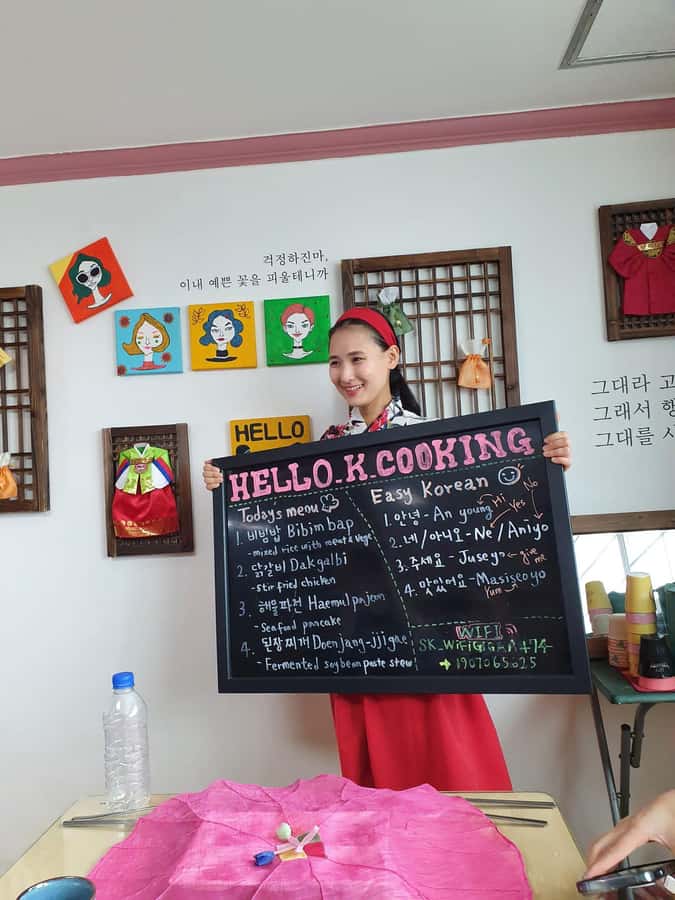
I think the value is good for the right person. You get more than four recipes: a local market visit, street-food tastings, a home setting, hands-on instruction, a Hanjeongsik meal, rice wine, cultural details, and recipes to use later.
Book it if you want a warm introduction to Korean food and prefer making lunch yourself over sitting in a restaurant. The small group, English instruction, and patient approach also make it a safe choice for first-time cooking-class participants.
Skip it if you need hotel transport, cannot manage stairs, or have dietary needs that the host cannot accommodate. Otherwise, this is a well-rounded way to spend three and a half hours in Seoul, especially if you want food, conversation, and a closer look at how Korean meals come together.
FAQ
Where does the cooking class meet?
Meet your guide outside exit 2 of Mangwon Station. You must make your own way to the meeting point because hotel pickup is not included.
How long does the experience last?
The activity lasts about three and a half hours. Starting times vary, so check availability when booking.
Which dishes will I cook?
You will prepare bibimbap, dakgalbi, haemul-pajeon, and doenjang-jjigae.
Is the class suitable for beginners?
Yes. The host provides step-by-step instruction, ingredients, and equipment, and the activity is designed for participants with different levels of cooking experience.
What food and drink are included?
The experience includes street-food samples, a welcome tea, the meal you prepare, more than 10 Hanjeongsik side dishes, rice, seasonal fruit, rice wine, and water.
Is hotel transportation included?
No. Hotel pickup and drop-off are not included. You are responsible for reaching Mangwon Station and returning from the meeting point after the activity.
Is the local home accessible by elevator?
No. There is no elevator to the local home, so you need to be able to use stairs.
Can dietary restrictions or allergies be accommodated?
You should contact the local host before booking to discuss dietary restrictions and allergies. The available arrangements are not specified, so confirm directly with the host.
More hands-on classes and workshops in Seoul
- Yongpyong Ski Resort from Seoul with Optional Lesson and Packages
★ 5.0 · 217 reviews - Korean Cooking Class with Grocery Shopping at Seoul Local Market
★ 5.0 · 107 reviews - Royal Seoul Cooking Class in a 100-Year-Old Hanok
★ 5.0 · 81 reviews - Seoul : Taste of Korea, Authentic Home-Style Cooking Class
★ 5.0 · 64 reviews
Just added around Seoul
- Your Personal Seoul Photographer!★ 4.1 · 15 reviews
- From Seoul: Hwacheon Ice Fishing and Lighting Festival Tour★ 4.5 · 4 reviews
- You’re Invited to Our Home in Seoul: The Only Cooking Class!★ 5.0 · 8 reviews
- Seoul: Gangneung BTS K-Pop & K-Drama Filming Locations Tour★ 4.6 · 14 reviews
- Unique Native Experience : Han River Picnic, Board game, BBQ★ 5.0 · 3 reviews
- 2-Hour Private Kayaking and Paddleboarding Experience in Hanriver★ 5.0 · 3 reviews
- Yun Korean Cooking Class in Seoul★ 5.0 · 6 reviews
- Day Trip to Yongin Daejanggeum and Korean Folk Village from Seoul★ 4.0 · 9 reviews
Seoul Traditional Market Tours, compared.

Gyeongbok Palace, Bukchon Village, and Gwangjang Tour
Read our review →

DMZ Tour Seoul to North Korea’s 3rd Tunnel & Majang Lake Crossing
Read our review →Gyeongbok Palace, Bukchon Village, and Gwangjang Tour
Read our review →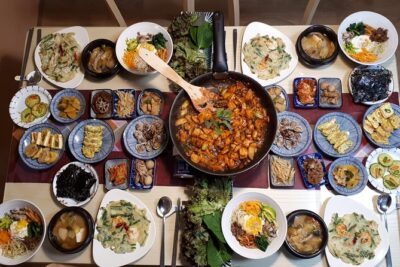
Local Home Korean Cooking Class & Market Adventure in Seoul
Read our review →
Downtown Seoul Guided Food & Market Tour with 8+ Local Tastings
Read our review →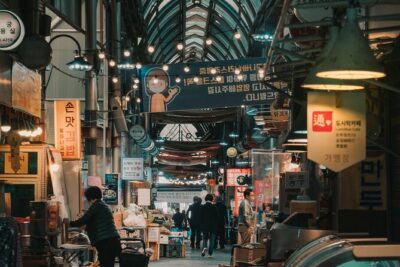
Seoul Night Palace & Market Food Tour with Vehicle
Read our review →Browse the lists this tour appears in